Showing posts with label apacall. Show all posts

Tuesday, November 13, 2018

EVO Minecraft MOOC travels to WorldCALL 5 in Concepción, Chile


I'm in Concepción, Chile, for my 3rd WorldCALL conference. They happen every five years. I was at the first one in Melbourne, Australia in 1998. I met Jeong Bae Son there and was asked to join him on the executive committee at APACALL (http://www.apacall.org/) shortly after that, and have been active in that organization ever since. I believe JB, as he likes to be called, will be in Concepción this year.

I missed the second WorldCALL in Banff in 2003 but went to Fukuoka in 2008. I was not able to attend Glasgow in 2013 but it looks like I'm consistently attending every other one. This one November 13 to 16, 2018, is only the 5th WorldCALL conference ever, http://worldcall5.org/.

EVO Minecraft MOOC at WorldCALL 5 in Concepción

My talk at WorldCALL 5 will be on Gamifying teacher professional development through Minecraft MOOC

Abstract

EVO Minecraft MOOC is an ongoing community of practice of language teaching practitioners which invites newcomers to join in every January / February and then continues throughout the year with a dedicated group of teaching peers who have been interacting online in Minecraft for the past 4 years. This presentation explains how the group was formed, how it functions, and what we have learned about gamifying learning by experiencing it ourselves when playing the game Minecraft with one another. More importantly we reflect continually on how this informs our approach to teaching and learning. This presentation shares our insights and perspectives with our audience and invites them to join us online if they wish to learn more about what gamification feels like as a learning experience.

Summary

Electronic Village Online is an annual teacher training event run under the auspices of TESOL CALL-IS. EVO Minecraft MOOC is a 5-week session that has taken place in Minecraft, a wiki, and Google+ Community space each Jan / Feb since 2015. The presenter conceived the idea for EVO Minecraft MOOC as a way that he himself could develop expertise in the game and thereby use it with students. Other teachers were attracted to the concept, including some who had some experience in the game. Participants were attracted to the session for the same reasons — not that their learning paths had been prescribed for them in a neatly pre-set syllabus but that by entering the “game” or session, learning would happen for them in a way that participants would come to understand by experiencing the process that Ito et al (2010) characterize as “hanging out, messing around, and geeking out.”

We have found that Minecraft is capable of reversing the normal student teacher dichotomy whereby teachers traditionally are assumed to know more than their students. We have found through the experience of participants in our EVO session that that participants tend to take charge of their learning by guiding one another in the vagaries of the game.

This presentation explains what teachers (who are learning about the game through the experience of playing it as learners) are learning about designing worlds within the game context that will meet their curriculum objectives and create an engaging and enjoyable experience and task-based environment for learners. But above all, the paper explores how teachers can be made aware of the affordances of Minecraft by creating such spaces for one another and interacting in those spaces. It also serves as an example of how we teachers can use what we have learned through our experience with MOOCs to form communities of practice to reboot our own learning, using the community as curriculum model (Cormier, 2008).

A trailer for my presentation in Concepción appears here


I blogged how this came about at my more frequently updated podcast blog here,
https://learning2gether.net/2018/11/01/vance-stevens-presents-lightning-talk-on-engaging-students-in-gamified-classrooms-using-minecraft/

The video was the result of a concatenation of events. I was taking an iTDi Teaching Online course facilitated by Heike Philp and one of the projects was to produce a video teaching something to an imaginary class of online learners. Meanwhile I had been asked to prepare a "lightning talk" of 5 or 6 minutes explaining EVO Minecraft MOOC for the Games and Learning Community Group session at EDUCAUSE in Denver and have it ready for their face-to-face session on November 1
https://events.educause.edu/annual-conference/2018/agenda/games-and-learning-community-group-session-open-to-all

The YouTube video is online here, https://youtu.be/aKzE43EsPsk. It is a quick run-through of the slides accompanying my WorldCALL 5 presentation, which I have placed online here:
https://tinyurl.com/vance2018worldcall


So that is the flipped learning side of my presentation in Concepción. Having done all this preparation, and as the slides are online, I plan to simply talk about them in the 30 minutes I have available to me at WorldCALL.

One thing I would like to emphasize in my presentation is something that Yuko Kato, one of my colleagues in the iTDi course, asked me: What is the language purpose of this? This is a question that is quite critical to keep in mind at a WordlCALL conference on computer assisted language learning.

I co-wrote an article which might be a good starting point, Smolčec, M., Smolčec, F. and Stevens, V. (2014). Using Minecraft for Learning English. TESL-EJ 18, 2. Available: http://www.tesl-ej.org/wordpress/issues/volume18/ej70/ej70int/. This gives many examples of students using MC to practice and improve learning a FL.

Several of the colleagues who appear in this article have formed a community of practice called EVO Minecraft MOOC. The purpose of this community is to help teachers experience the affordances of MC for communication, critical thinking, problem solving ... all elements underpinning real communication i.e. the desire to learn and use a language. The following article explains how EVO Minecraft MOOC helps teachers to understand the participatory culture which players enter and how to apply the affordances of the game to language learning contexts, Stevens, V. (2017). Gamifying Teacher Professional Development through Minecraft MOOC. In Zoghbor, W., Coombe, C., Al Alami, S. & Abu-Rmaileh, S. (Eds.). Language Culture Communication: Transformations in Intercultural Contexts. The Proceedings of the 22nd TESOL Arabia Conference. Dubai: TESOL Arabia. Pages 75-92. Available: http://vancestevens.com/papers/evomcmooc_TACON2016.pdf


I'm trying to get Flipgrid to work. The following is experimental ...

View my Flipboard Magazine.

Writingmatrix at WorldCALL 3 in Fukuoka

I preserved the following notes from WorldCALL 3 in Fukuoka in 2008

At the August 6-9, 2008 WorldCALL congress in Fukuoka, Japan, http://www.j-let.org/~wcf/modules/tinyd0/, my 45 min. session on Engaging collaborative writing through social networking was listed in the program at http://www.j-let.org/~wcf/docs/Web_20080728.htm in the Aug 6 time slot from 17:25 to 18:10 Tokyo time. Nelba Quintana, a collaborator on the Writingmatrix project I was reporting on, joined me at the podium for the presentation.
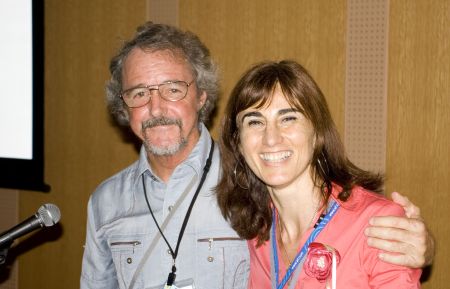

Nelba Quintana and I after we gave our presentation - photo by Joseph Dias
As mentioned, Nelba Quintana, one of the original Writingmatrix teachers, joined me at my session, and Rita Zeinstejer and Sasa Sirk joined in online, as you can hear in the recording.


Several Webheads (http://webheads.info) attended this conference. Some are shown in the photo above, taken by Tom Robb (also a Webhead). They might have been about to listen to Vera Menezes give an interesting plenary address on CALL development in the context of chaos theory and how strange attractors create butterfly effects impacting subsequent development of a field like CALL felt all around the world. For example ... imagine huge auditorium, huge screen dwarfing tiny podium with speaker on stage, who clicked on a slide on ... Webheads in Action, and another slide on Writingmatrix. Erika Cruvinel was also mentioned in one of Vera's slides where she talked about Erika's model project sharing with Claudia's class in La Plata. 

I found this picture at the Webheads Posterous blog which was moved (when Posterous shut down) here http://webheadsinfukuoka.wordpress.com/.

I wrote up my talk for the conference proceedings

Stevens, Vance. (2009 July 15). Engaging Collaborative Writing through Social Networking. In Koyama, Toshiko; Noguchi, Judy; Yoshinari,Yuichiro; and Iwasaki, Akio (Eds.). Proceedings of the WorldCALL 2008 Conference. The Japan Association for Language Education and Technology (LET). ISBN: 978-4-9904807-0-7, http://www.j-let.org/~wcf/proceedings/proceedings.pdf pp.68-71.

My paper Engaging Collaborative Writing through Social Networking appears in the online version of the WorldCALL 2008 proceedings http://www.j-let.org/~wcf/modules/tinyd12/index.php?id=5. The paper linked from those proceeds is available here http://www.j-let.org/~wcf/proceedings/d-052.pdf, while a proof version can be found here http://www.vancestevens.com/papers/archive/WorldCALL2008_proceedings_vancestevens.pdf) 


Friday, November 30, 2007

Webheads as agents of change in overlapping clouds of distributed learning networks

This is being prepared as a contribution to the APACALL Newsletter, http://www.apacall.org/news/news.html. I've been asked to write a 'three-page blurb on Webheads.'

Webheads is a group of enthusiasts keen on learning as much as possible about the role of technology in education and just as eager to help one another on our individual paths to learning and discovery. In this respect we have networked, or converged, or grouped together, as an anecdote to the problem of recidivism in teacher professional development, discussed in my previous posting here: http://advanceducation.blogspot.com/2007/11/wow-of-week-recidivism-in-teacher.html

Webheads started in 1998 as a community of language learners and teachers who began meeting online about then, at a distance, to develop their skills in the learning and teaching of writing in English. In these days before blogging and the advent of the read-write century, Webheads were enabling learners to get to know and interact with one another by posting writings on mailing lists (interactive) and websites (static) with faces of writers appearing in thumbnail portraits next to their compositions, an idea that only later became well-known as a feature in Moodle and other socially oriented educational environments <http://www.homestead.com/prosites-vstevens/files/efi/webheads.htm>. Participants in Writing for Webheads strengthened their bonds by meeting synchronously each Sunday noon GMT. At the start, meetings were in a compelling avatar-based space called The Palace, but when around the turn of the century it became possible to mount synchronous voice chat at our website, Webheads lost no time adding this new dimension to our weekly interactions, and from that time on we began attracting the attention of other online teachers, whom we invited to interact with us at first informally, but then at online events which we mounted at conferences, frequently online.

But with increasing frequency we were invited to appear at face to face events to show delegates at international conferences firsthand how easy it was to engage students in communication with one another using online tools freely available over the Internet. As more teacher voices joined our community, those of the students began to be suppressed. Seeing the need for separate teacher and learner groups, I formed Webheads in Action (WiA) as a session in the second TESOL/EVO annual training event in 2002. EVO, or Electronic Village Online, is a set of free grass-roots professional development seminars on various topics in language learning which take place the first two months of every year (see: http://academics.smcvt.edu/cbauer-ramazani/TESOL/EVOL/portal.htm).

The timing was impeccable as WiA was at the cutting edge of a movement that was soon to define use of the Internet in the read-write Web century that had just begun the new millennium. We were yet to see the tools which would carry this movement foreward, tools such as blogs, wikis, YouTube, and the proliferation of social networking sites. Yet the impetus was well in place and that first group of teaching practitioners became a dedicated core who have for the most part remained loyal to this beginning in 2002. "Becoming a Webhead" has been offered at every EVO event since 2004, and has in each instance been put on by participants in prior Webheads EVO sessions. Meanwhile, the Yahoo Group which served the first EVO session in 2002 has grown to well over 600 members (and anyone is welcome to join at http://groups.yahoo.com/group/evonline2002_webheads).

Webheads have morphed in how they perceive themselves. In 2002 we thought of ourselves as a phenomenon which had emerged online from a YahooGroup, but this feeling of group quickly developed into the idea that we were a community, and for our first few years we explored the notion that we were a community of practice. This attracted a number of studies, including a dissertation on our group by Webhead Dr. Chris Johnson, which in turn led Etienne Wenger, perhaps the best known writer and researcher on communities of practice, to alter his notions of the CoP paradigm and explain how WiA had influenced his thinking at one of our online Webheads in Action Online Convergences, WiAOC 2007 (referenced below).

More recently, I have come to think of ourselves more as a network than as a community or group. I have been influenced in my thinking largely by George Siemens and his writings on Connectionism (2004) and by Stephen Downes and his numerous writings and podcasts, including his appearance at WiAOC 2007 at which he drove the point home (see also his slide show from a presentation on Distributed Learning, April 3, 2006, at http://www.slideshare.net/Downes/distributed-learning). Indeed, what Downes refers to as a distributed learning network seems to me to characterize the connections in Webheads and our overlap with a Venn diagram patchwork of other communities often largely populated by Webheads members.

The question of what constitutes a Webhead 'member' often comes up. I suppose you are recognized officially as a Webhead if you have enrolled in the YahooGroup, or in the Worldbridges drupal portal at http://www.webheadsinaction.org. Or you might consider yourself a Webhead if you frequent any of the sites listed in the portal that links to all the other Webhead portals here: http://webheads.info. I tell people that being a Webhead is like being a hippy. You know if you are one. And if you are one and see another one, there is likely to be an affinity between the two of you.

This notion of membership dissipates with the degree to which you consider yourself to be more a node on the network than a member of a group. The grouping is then defined by its connections, not by a particular sense of membership. In this perception, each node connects to many others and one cloud of connections might be called Webheads whereas many of the Webheads nodes might have tentacles linking to another cloud called EVO, which in turn would have nodes networked elsewhere but not necessarily directly to Webheads. To take another example, there is a cloud of networked nodes referred to as APACALL (the entity in whose newsletter this posting will soon appear), and many of those nodes reach back into Webheads. At each of our WiAOC convergences, APACALL members have interacted with Webheads as members of panels mounting presentations at those online conferences, so in a network sense, APACALL participants might feel themselves to be a part of the Webhead cloud of networked nodes, though they may not have necessarily joined the WiA YahooGroup, so they wouldn't in that sense be considered as Webheads 'members'. But they might have enrolled in the Worldbridges portal, and here would be another stimulating network, many of whose nodes reach also into the Webheads cloud.

What's interesting about this is what happens with "knowledge" in a network. Downes has a 'Where's Waldo' definition of what it means to know. You don't know where Waldo is until you know, and once you know, you can't not know it. This is a personal definition of knowledge, but we can't all know where Waldo is every time we need to find him, and this is where Webheads rely on their networks. Jay Cross says in his book on informal learning that "The work of the future is knowledge work." David Warlick pointed out in his recent K-12 Online Conference keynote that whereas his father learned in college what he would need to know for the remainder of his working life, his children would have no such assurance. In a so-called 'flat' world where the jobs we teachers train our students for have not been invented yet, those most competitive in the most likely future will be those whose networking skills are most sophisticated and refined.

This I think is what Webheads are about. We encourage one another to enhance our networking skills, learning the tools most appropriate for this as we use them with each other. We model for one another the most appropriate systems for enhancing connectionism and the sharing of knowledge within our distributed learning networks. As we ourselves become more familiar with the basic essential tools, we carry them into our workplaces and classrooms. As we involve our peers and students in effective ways of learning, we model for them, to try and break that cycle of recivitism, of going back to ways of teaching and learning that are becoming increasingly outmoded the further we get into the read-write century, the century where the knowledge worker will prevail.

Webheads are change agents. We work on the easy part first, to change one another. It's harder to effect change with those who are not yet networked or not so committed to learning that they will pay more than lip service to the pursuit of learning full time, which is what lifelong learning is. But the secret is not in teaching, not in assembling groups of students, like horses led to water. The key is in modeling, in showing people how to successfully network, to aggregate content, to work toward the creation of folksonomies through tagging, to pull in knowledge through imaginative use of key technologies like RSS rather than relying on what is pushed their way in email spam and glut of attachments. Another key is to connect, to interact with a network, to touch base frequently with other nodes in your distributed learning network.

But if you're reading this blog, you probably already know that (and if you're not reading this ... beyond reach?? ... sigh ... what's the use?).

As a final illustration of the points made here, an example means by which a distributed learning network might aggregate content, let's look up blog postings tagged webheadsinaction in Technorati, searching for blogs with 'any' authority: http://technorati.com/tag/webheadsinaction?authority=n&language=en

The result yields some insights into connections within our networked community. The first that I find today is a post by Nancy White entitled Community Indicator: Condolences,
citing "a blog that allows a distributed community of practice to share their condolences with a member whose father died." This might not be the kind of knowledge you would expect to be shared in a distributed learning network promoting professional development, as it refers to a personal situation not normally discussed among professionals. Yet read on to the next post, "Miso stalks Spike," an installment in the adventures of a Webhead from Canada who is on an extended trip by van to Mexico (and whom I had encouraged to tag her blog posts 'webheadsinaction' so we in the community would be able to locate and read her posts). Next, there are YouTube videos, including one of Carla's son Dudu explaining the meaning of thanksgiving (Carla is from Brazilia but has just moved to Key West, where her son is showing off an remarkable command of assimilated language and culture). What is all this, you might ask? Not what you expected? It's another key ingredient of Webheads, from the days of thumbnails next to writings and voices in synchronous chat. That ingredient is personality.

Caring about one another is the secret ingredient that has held this community together for almost ten years now. That, plus a proven track record of keeping one another at the cutting edge of educational technology over the past decade while introducing newcomers to the process in an effective and non-threatening manner.


References

Cross, Jay. (2007). Informal Learning. John Wiley & Sons, Inc.

Downes, Stephen. (2007). Personal Learning the Web 2.0 Way. Presented at WiAOC 2007 - http://www.webheadsinaction.org/wiaoc2007/StephenDownes.
Slides: http://www.slideshare.net/Downes/personal-learning-the-web-20-way.
Recordings: Part 1: http://streamarchives.net/node/84;
Part 2: http://streamarchives.net/node/83

Johnson, Christopher M. "Establishing an Online Community of Practice for Instructors of English as a Foreign Language." Ph.D. Dissertation in Computing Technology in Education from Nova Southeastern University

This case study examined an online group's degree and presence of CoP characteristics, as gleaned from CoP theory. The study analyzed the group's synchronous and asynchronous communication to determine what areas received the most and least "airplay", and how they changed over time. One topic for discussion is how this type of analysis can be used (e.g., comparison to another type of online group, maturity stage of a CoP, "health" of a CoP, etc.). - From CPSquare News, September 7, 2006, http://www.cpsquare.org/News/archives/000073.html

Siemens, George. (2004). Connectivism: A Learning Theory for the Digital Age. elearnspace. http://www.elearnspace.org/Articles/connectivism.htm.

Warlick, Davd. (2007). Derailing Education: Taking Sidetrips for Learning. Keynote presentation at K-12 Online Conference. http://k12onlineconference.org/?cat=7

Wenger, Etienne. (2007). Conversation with Suzanne Nyrop. Presentation at WiAOC 2007 - http://www.webheadsinaction.org/wiaoc2007/EtienneWenger.
Slides: http://www.flickr.com/photos/netopnyrop/503628210/in/set-72157600229137116/.
Recordings - Part 1: http://streamarchives.net/node/56;
Part 2 : http://streamarchives.net/node/55

Bibliography on Webheads

Stevens, Vance. 2006. Guest Editor's Introduction: Proceeds of Webheads in Action Online Convergence: Volume 2. In Stevens, V. (Ed.) IATEFL Poland Computer Special Interest Group Teaching English with Technology A Journal for Teachers of English ISSN 1642-1027 Vol. 6, Issue 3 (August 2006). http://www.iatefl.org.pl/call/j_edit25.htm

Stevens, Vance. 2006. Guest Editor's Introduction: Proceeds of Webheads in Action Online Convergence: Volume 1. In Stevens, V. (Ed.) IATEFL Poland Computer Special Interest Group Teaching English with Technology A Journal for Teachers of English ISSN 1642-1027 Vol. 6, Issue 2 (May 2006). http://www.iatefl.org.pl/call/j_edit24.htm

Stevens, V. (2004). Webheads communities: Writing tasks interleaved with synchronous online communication and web page development. In Leaver, B. and Willis, J. (Eds.). Task-based instruction in foreign language education: Practices and programes. Georgetown University Press. pp. 204-217.
  • There is a full text of a late draft of my article here, though references are not included: http://www.homestead.com/prosites-vstevens/files/efi/papers/taskbase_ch10june192003.htm.
  • Here is a Commentary: from the Linguis list, May 2005. AUTHORS: Leaver, Betty Lou; Willis, Jane R. TITLE: Task-Based Instruction in Foreign Language Education SUBTITLE: Practices and Programs PUBLISHER: Georgetown University Press YEAR: 2004 "CHAPTER TEN: Webhead communities: Writing tasks interleaved with synchronous online communication and web page development (Vance Stevens) Another instance of virtual classroom implementing writing tasks is described in this chapter. The author reports activities of groups of learners and teachers involved in online writing practices. The writing tasks were aimed at purposeful interaction and technology was a vehicle of implementing pedagogical principles not the driving force. The author's initiative for conducting an online writing and grammar course is reported to have been the starting point of this community of online writers called Webheads. The group interactions involved various topics including projects on which teachers interacted and themes and tasks of interest to learners. Cost, ease of use, multicasting capability, and cross platform adaptability were the criteria in selecting the tools for computer mediated communication. Email groups, web pages, and synchronous chat were the major modalities of interaction and implementation of tasks. After a brief discussion on evaluation and in the conclusion section the author mentions lowering affective obstacles and promoting a sense of community as the main message from the project and recommends that the model be applied in other situations. In an appendix some technology related issues are dealt with.

Stevens, V. and Altun, A. (2002). The Webheads community of language learners online. In Syed, Z. (Ed.). The process of language learning: An EFL perspective. Abu Dhabi: The Military Language Institute. pp. 285-318. There is a pre-publication version of this paper at http://sites.hsprofessional.com/vstevens/files/efi/papers/t2t2001/proceeds.htm

Stevens, Vance. 2001. Developing a Community in Online Language Learning. In Syed, Zafar, and David Heuring, eds. Tools of the Trade: Teaching EFL in the Gulf. Proceeds of the Military Language Institute's 1st annual Teacher-to-Teacher Conference, May 3-4, 2000, Abu Dhabi (UAE) pp 85-101, and on the web at http://lightning.prohosting.com/~vstevens/t2t2000/gvs_t2t_paper.htm.

Coghlan, M. and Stevens, V. 2000. An Online Learning Community -- The Students' Perspective. Paper presented at the Fifth Annual Teaching in the Community Colleges Online Conference, April 12-14, 2000. Retrieved May 6, 2005 from http://www.chariot.net.au/~michaelc/TCC2000.htm

Stevens, Vance. 1999. Writing for Webheads: An online writing course utilizing synchronous chat and student web pages. A paper submitted for the 4th Annual Teaching in the Community Colleges Online Conference: Best Practices In Delivering, Supporting & Managing Online Learning, April 7-9, 1999 - http://sites.hsprofessional.com/vstevens/files/efi/hawaii99.html

Notes:

A Newsletter ready version of this post appears here:
http://webheadlink.wordpress.com/2007/11/30/webheads-as-agents-of-change-in-overlapping-clouds-of-distributed-learning-networks/

This article has since been published here:
Stevens, Vance. (2007). Webheads as agents of change in overlapping clouds of distributed learning networks. APACALL Newsletter 11, pp. 3-8. Retrieved December 18, 2007 from: http://www.apacall.org/news/Newsletter11.pdf.