Showing posts with label webheads in action. Show all posts

Tuesday, November 13, 2018

EVO Minecraft MOOC travels to WorldCALL 5 in Concepción, Chile


I'm in Concepción, Chile, for my 3rd WorldCALL conference. They happen every five years. I was at the first one in Melbourne, Australia in 1998. I met Jeong Bae Son there and was asked to join him on the executive committee at APACALL (http://www.apacall.org/) shortly after that, and have been active in that organization ever since. I believe JB, as he likes to be called, will be in Concepción this year.

I missed the second WorldCALL in Banff in 2003 but went to Fukuoka in 2008. I was not able to attend Glasgow in 2013 but it looks like I'm consistently attending every other one. This one November 13 to 16, 2018, is only the 5th WorldCALL conference ever, http://worldcall5.org/.

EVO Minecraft MOOC at WorldCALL 5 in Concepción

My talk at WorldCALL 5 will be on Gamifying teacher professional development through Minecraft MOOC

Abstract

EVO Minecraft MOOC is an ongoing community of practice of language teaching practitioners which invites newcomers to join in every January / February and then continues throughout the year with a dedicated group of teaching peers who have been interacting online in Minecraft for the past 4 years. This presentation explains how the group was formed, how it functions, and what we have learned about gamifying learning by experiencing it ourselves when playing the game Minecraft with one another. More importantly we reflect continually on how this informs our approach to teaching and learning. This presentation shares our insights and perspectives with our audience and invites them to join us online if they wish to learn more about what gamification feels like as a learning experience.

Summary

Electronic Village Online is an annual teacher training event run under the auspices of TESOL CALL-IS. EVO Minecraft MOOC is a 5-week session that has taken place in Minecraft, a wiki, and Google+ Community space each Jan / Feb since 2015. The presenter conceived the idea for EVO Minecraft MOOC as a way that he himself could develop expertise in the game and thereby use it with students. Other teachers were attracted to the concept, including some who had some experience in the game. Participants were attracted to the session for the same reasons — not that their learning paths had been prescribed for them in a neatly pre-set syllabus but that by entering the “game” or session, learning would happen for them in a way that participants would come to understand by experiencing the process that Ito et al (2010) characterize as “hanging out, messing around, and geeking out.”

We have found that Minecraft is capable of reversing the normal student teacher dichotomy whereby teachers traditionally are assumed to know more than their students. We have found through the experience of participants in our EVO session that that participants tend to take charge of their learning by guiding one another in the vagaries of the game.

This presentation explains what teachers (who are learning about the game through the experience of playing it as learners) are learning about designing worlds within the game context that will meet their curriculum objectives and create an engaging and enjoyable experience and task-based environment for learners. But above all, the paper explores how teachers can be made aware of the affordances of Minecraft by creating such spaces for one another and interacting in those spaces. It also serves as an example of how we teachers can use what we have learned through our experience with MOOCs to form communities of practice to reboot our own learning, using the community as curriculum model (Cormier, 2008).

A trailer for my presentation in Concepción appears here


I blogged how this came about at my more frequently updated podcast blog here,
https://learning2gether.net/2018/11/01/vance-stevens-presents-lightning-talk-on-engaging-students-in-gamified-classrooms-using-minecraft/

The video was the result of a concatenation of events. I was taking an iTDi Teaching Online course facilitated by Heike Philp and one of the projects was to produce a video teaching something to an imaginary class of online learners. Meanwhile I had been asked to prepare a "lightning talk" of 5 or 6 minutes explaining EVO Minecraft MOOC for the Games and Learning Community Group session at EDUCAUSE in Denver and have it ready for their face-to-face session on November 1
https://events.educause.edu/annual-conference/2018/agenda/games-and-learning-community-group-session-open-to-all

The YouTube video is online here, https://youtu.be/aKzE43EsPsk. It is a quick run-through of the slides accompanying my WorldCALL 5 presentation, which I have placed online here:
https://tinyurl.com/vance2018worldcall


So that is the flipped learning side of my presentation in Concepción. Having done all this preparation, and as the slides are online, I plan to simply talk about them in the 30 minutes I have available to me at WorldCALL.

One thing I would like to emphasize in my presentation is something that Yuko Kato, one of my colleagues in the iTDi course, asked me: What is the language purpose of this? This is a question that is quite critical to keep in mind at a WordlCALL conference on computer assisted language learning.

I co-wrote an article which might be a good starting point, Smolčec, M., Smolčec, F. and Stevens, V. (2014). Using Minecraft for Learning English. TESL-EJ 18, 2. Available: http://www.tesl-ej.org/wordpress/issues/volume18/ej70/ej70int/. This gives many examples of students using MC to practice and improve learning a FL.

Several of the colleagues who appear in this article have formed a community of practice called EVO Minecraft MOOC. The purpose of this community is to help teachers experience the affordances of MC for communication, critical thinking, problem solving ... all elements underpinning real communication i.e. the desire to learn and use a language. The following article explains how EVO Minecraft MOOC helps teachers to understand the participatory culture which players enter and how to apply the affordances of the game to language learning contexts, Stevens, V. (2017). Gamifying Teacher Professional Development through Minecraft MOOC. In Zoghbor, W., Coombe, C., Al Alami, S. & Abu-Rmaileh, S. (Eds.). Language Culture Communication: Transformations in Intercultural Contexts. The Proceedings of the 22nd TESOL Arabia Conference. Dubai: TESOL Arabia. Pages 75-92. Available: http://vancestevens.com/papers/evomcmooc_TACON2016.pdf


I'm trying to get Flipgrid to work. The following is experimental ...

View my Flipboard Magazine.

Writingmatrix at WorldCALL 3 in Fukuoka

I preserved the following notes from WorldCALL 3 in Fukuoka in 2008

At the August 6-9, 2008 WorldCALL congress in Fukuoka, Japan, http://www.j-let.org/~wcf/modules/tinyd0/, my 45 min. session on Engaging collaborative writing through social networking was listed in the program at http://www.j-let.org/~wcf/docs/Web_20080728.htm in the Aug 6 time slot from 17:25 to 18:10 Tokyo time. Nelba Quintana, a collaborator on the Writingmatrix project I was reporting on, joined me at the podium for the presentation.
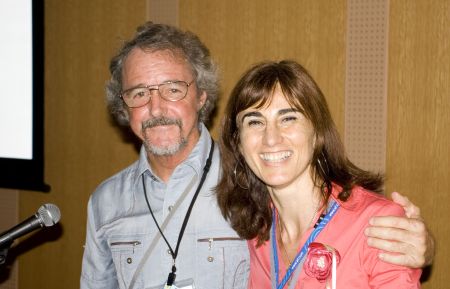

Nelba Quintana and I after we gave our presentation - photo by Joseph Dias
As mentioned, Nelba Quintana, one of the original Writingmatrix teachers, joined me at my session, and Rita Zeinstejer and Sasa Sirk joined in online, as you can hear in the recording.


Several Webheads (http://webheads.info) attended this conference. Some are shown in the photo above, taken by Tom Robb (also a Webhead). They might have been about to listen to Vera Menezes give an interesting plenary address on CALL development in the context of chaos theory and how strange attractors create butterfly effects impacting subsequent development of a field like CALL felt all around the world. For example ... imagine huge auditorium, huge screen dwarfing tiny podium with speaker on stage, who clicked on a slide on ... Webheads in Action, and another slide on Writingmatrix. Erika Cruvinel was also mentioned in one of Vera's slides where she talked about Erika's model project sharing with Claudia's class in La Plata. 

I found this picture at the Webheads Posterous blog which was moved (when Posterous shut down) here http://webheadsinfukuoka.wordpress.com/.

I wrote up my talk for the conference proceedings

Stevens, Vance. (2009 July 15). Engaging Collaborative Writing through Social Networking. In Koyama, Toshiko; Noguchi, Judy; Yoshinari,Yuichiro; and Iwasaki, Akio (Eds.). Proceedings of the WorldCALL 2008 Conference. The Japan Association for Language Education and Technology (LET). ISBN: 978-4-9904807-0-7, http://www.j-let.org/~wcf/proceedings/proceedings.pdf pp.68-71.

My paper Engaging Collaborative Writing through Social Networking appears in the online version of the WorldCALL 2008 proceedings http://www.j-let.org/~wcf/modules/tinyd12/index.php?id=5. The paper linked from those proceeds is available here http://www.j-let.org/~wcf/proceedings/d-052.pdf, while a proof version can be found here http://www.vancestevens.com/papers/archive/WorldCALL2008_proceedings_vancestevens.pdf) 


Wednesday, January 27, 2016

Networking, and playing the Big G Game of EVO Minecraft MOOC

By Vance Stevens
English Faculty, HCT / CERT / KBZAC, Al Ain UAE


Abstract:
This post relates how #evomc16 co-moderators are using Minecraft to help teachers understand how gamification might work for them in their classrooms by giving all concerned the experience of interacting in the game.

But Minecraft turns out to be only a vehicle for understanding the wider concept of gamification. By building elements of gamification into EVO Minecraft MOOC, this session becomes a Big G game space where participants can meet other educators to learn how their students can benefit from gamified environments. So participants here (as well as moderators) are developing their understanding of gamification while enjoying playing in the little g game of Minecraft.

Gamification is modeled in the Big G Game space through creation of a Google+ community "gameboard" and having participants figure out from there what they have to do to play the game. Eventually they end up in Minecraft in creative mode. They then graduate to coping with survival in the more challenging game environment, and through that experience learn that gamification is all about teamwork, mutual support, meeting challenges, and achieving goals, whatever they are, and however they themselves define them. 

The ‘aha’ moment occurs when the players succeed in both the upper and lowercase games and realize that, if what they were trying to teach were placed in such a context, it would not only become more engaging to the learners, but their students would be taking their own learning into their own hands. This can create a powerful learning environment, but educators need to experience it for themselves in order to understand it.

Electronic Village Online (EVO, http://evosessions.pbworks.com) takes place every year (since 2001) and this year runs from January 10 to February 13, 2016. EVO Minecraft MOOC (EVOMC16) is now in its second year as one of these sessions, http://evosessions.pbworks.com/w/page/103533067/2016_EVO_Minecraft_MOOC .

There are 185 people enrolled in the Google+ community that serves as the base for EVOMC16, https://plus.google.com/u/0/communities/112993649763396826671, but far fewer actively engaged participants. For this small coterie, it seems to be going well. They have found in the Google+ community page the link to the syllabus, http://tinyurl.com/evomc16-syllabus, which points to a set of missions here: http://missions4evomc.pbworks.com/. The missions are pretty straightforward -- or, they must be, as participants seem to be finding them and doing them without asking too many questions, and when they do ask and the moderators respond, the response seems to get them on task.

Gee (2008, p.24) distinguishes the little ‘g’ game, the software comprising a game such as Minecraft, and the Big ‘G’ game or "social setting" that the little ‘g’ game helps to gamify. Going to the Google+ community page and figuring out where the session components are and what you are supposed to do with them is how you play the Big G Game of EVO Minecraft MOOC. Completing the 10 missions (or a to-be determined number) leads to the awarding of an EVOMC16 survivors badge. Evidence of completion of the required missions is recorded in a Google spreadsheet which is in turn linked from a click on the badge. The badge is awarded through Credly. The Credly system validates awards through specification of criteria needed to earn a badge. A link from the badge awarded directs anyone who clicks on your award to an open document displaying verifiable evidence of what was accomplishment.
2015-02-07_0521evominecraft_credly.png
The missions are, for weeks 1 and 2:
  1. Introduce yourself on our Google+ Community  
  2. Install and enter our voice tool so we can communicate in VoIP while in-world
  3. Fill in the Google Registration form
  4. Reflect on your activities for Weeks 1-2
  5. Join the Missions Accomplished Google sheet
  6. Join us in Minecraft
These missions have provided our demographics for this session and shown us who we are likely to be working with through to the end of the session. As things stand midway through the session:
  • Although we have 185 members on our Google+ Community, this doesn’t give us much of an indication of who is with us in 2016 because we are continuing a community that we started last year. 
  • But from Mission 3, we see that around 30 participants have filled in the Google form “enrolling” them in the session.
  • Of these, 21 provided Minecraft usernames, which are needed to whitelist them on the server. So at this point in the session, we have around 21 participants with access to our server, plus 7 active moderators, and a few others besides.
  • Our most rigorous test of commitment is completion of Mission 5, where participants must request access to our Google Sheet in order to track their ten missions accomplished. Midway through the session, a little over half a dozen participants had joined that document, but this number is likely to increase as the session goes on, since completion of missions leads to awarding of badges.
What our participants lack in number they have been making up for in energy. Our server in creative mode has been attracting some impressive builds. Here are a few who have posted their achievements on our Google+ Community page.  
  1. Yvonne Harrison has documented some incredible structures on her Flickr feed, linked from here http://yvonneh.edublogs.org/2016/01/26/evo_mooc-minecraft-server-5/.
  2. Thorsten Gross has posted pictures of his builds here https://paradigmagnus.wordpress.com/2016/01/14/minecraft-mooc-tumbling-down-the-world-of-cubes/, and of a project he was involved with at Ricarda-Huch-Schule in Dreieich, Germany, here, https://plus.google.com/113742735224806254960/posts/QoNJNUKbwkG
  3. Kathleen Kerney created a lovely garden, https://plus.google.com/109894618020189345959/posts/epWNDxXccVG
  4. Beth Evans is prepping for survival, https://eslbeth.wordpress.com/2016/01/25/prepping-for-survival/
  5. Beth O’Connell has created a library house, http://booklady9.edublogs.org/2016/01/24/inworld-maps-in-minecraft/
  6. Ellen Clegg made a good start on her house, https://mcecsite.wordpress.com/2016/01/23/finally-getting-to-play-around-woo-hoooo/
  7. Moderators Jeff Kuhn and Aaron Schwartz have been busy creating whimsical structures such as a towering Sargon’s castle, and a zombie pit where buttons summon monsters (so participants can practice dispatching them) https://plus.google.com/+AaronSchwartz_oh/posts/TUqjApWXHZ2
  8. Micea Patrascu has been making some phenomenal builds with secret mechanisms and logic gates, and putting train tracks through tunnels around the server connecting them. I made a video of one of the train rides: https://youtu.be/nL02Sh-rmss which you can find embedded in my blog post at Stevens (2016).

Mircea Patrascu shows where this train ride ends up, at his subway stop, in his post here: 
https://evominecraftmp.wordpress.com/2016/01/28/a-day-in-evo-minecraft-world/
Mircea shows where this train ride ends up, at his subway stop, in his post here: https://evominecraftmp.wordpress.com/2016/01/28/a-day-in-evo-minecraft-world/. Mircea's post to the EVO Minecraft MOOC Google+ Community gives his incredible video overview of the roller coaster at the train station end of the ride, which as you can see in the comments to that post, he created with his son:
https://plus.google.com/+MirceaPATRASCU/posts/hekx7koKFW6.


In order to access the roller coaster, you have to answer three questions about Minecraft. When the switches with the answers are correctly set, a door opens, and you can push a button to set the train in motion. Enjoy this ride!


It looks like the participants mentioned above are well on their way to earning their badges, and there are only a few missions left to accomplish. These are set in weeks 3 and 4 of the session, with week 5 being set aside for consolidation, learning from one another, helping others who might be inspired to catch up, and of course helping each other stay alive in survival mode. The transition to survival mode is planned for week 4, and will continue for as long as the server stays alive and properly maintained in Aaron’s office at Ohio University.
The focus of Week 3 has been Networking, finding out what’s available in the wider world of Minecraft.

For week 3 the missions are to
  1. Explore other networks in Minecraft
  2. Build something in creative mode on our server
and for week 4 to
  1. Create pictures or video of you in survival mode
  2. Reflect on your experiences in survival mode
Each set of missions is described in a page at our missions wiki; for example this one for week 3, on networking: http://missions4evomc.pbworks.com/w/page/103905655/2016_Week3_Network

Apart from the several networks of educators using Minecraft mentioned there, networking activities in our group included:
  • Bron Stuckey’s online presentation in Week 3 where she filled us in on how others were incorporating Minecraft in promoting learning from among her extensive network of connected educators, http://learning2gether.net/2016/01/24/bron-stuckey-and-evo-minecraft-mooc-projects-and-challenges-designing-and-building/
  • Yvonne Harrison posted about what she is learning about the wider Minecraft networks https://plus.google.com/115571422706001108741/posts/9ram2vWXVo4 
  • On Sunday Jan 31 Thorsten Groß has arranged for his students at Ricarda-Huch-Schule to show us around an elaborate build they created there, an instantiation of Bron Stuckey's advice that Minecraft helps us turn learning over to the students. Thorsten and his students will conduct a tour through the world of their school reconstructed in Minecraft, as shown in this post, https://plus.google.com/113742735224806254960/posts/6MuW3CP1Pmb.
    They started to do this at
    a BarCamp about games, where the idea of reconstructing their whole school was planned and later on finished by students themselves. This event is scheduled for January 31, 2016, and is one of several events we hope to arrange to showcase the accomplishments of participants in our own extended network.
The networking aspect is what we focus on in this and other sessions like it. Most participants are starting to figure out that effectively networking is the key to success in the Big G game. This is modeled in the design of the EVO session, and in how the session is conducted. Not only are participants learning a lot about about Minecraft but they are starting to find their way about the EVO session itself. They're figuring out that the session is itself set up itself like a game.

Why is it like a game? There are two answers to the question. 
  • The first answer is that it was designed that way. It was designed to inculcate for teachers what gamification actually feels like. 
  • The second answer to the question of why EVOMC16 is like a game is because it is. By that I mean, the Big G Game of Minecraft MOOC has some rules with flexibility, goals and challenges, and awards in the form of badges. It's also much like a game because participants have to figure out these rules, it's designed to let them to figure it out as a built-in part of the game, and as in any game, it it's more fun if it doesn't play out the way anyone especially anticipated. 
This is normal for the app culture. When you go to Facebook and Google+, you don't get clear instructions. You're thrown into an interface and you see what's there and work out what you're supposed to do and how it will benefit you. So for participants who want to play the Big G game of EVOMC16, they go to our Google+ page where they find a sidebar with links they can click on. One of the links is to a syllabus, an outline of what they'll be doing each week during the session. The weeks are themed on Cormier's (2010) well-known five phases of coping in MOOCs, i.e. orient, declare, network, cluster, and focus (see Stevens, 2015, for elaborated explanation).

The syllabus alludes to missions that must be accomplished each week, and links point participants to the wiki where there is more information about each of the missions. The missions have participants do basic things like purchase Minecraft, get a username, introduce themselves to the community, join us in-world in creative mode in order to practice for our shift to survival, and fill in the Google sheet where participants will track their missions accomplished in pursuit of the one badge on offer at the moment. 

As of now we have just completed Week 3 on networks of educators using Minecraft. One aspect of networking is reaching out to the community within. We are hoping to arrange other tours with members of our community, such as the one by Thorsten Gross mentioned above, as our participants are turning out to be a rich source of modeling for all of us

I laid out our Big G goals in response to this post to our Google+ community by Kathleen Kearney, https://plus.google.com/109894618020189345959/posts/epWNDxXccVG.

We are all learning about gamification here, it's not so much about Minecraft. Minecraft is the little g game, the enabler of our emerging knowledge of gamification. When you enter survival mode you'll find that you are assisted by others in world. With their help you stay alive and learn. So gamification turns out to be learning through teamwork and mutual support and meeting challenges and achieving your goal, whatever it is. In this game you set your own goals. By achieving your goals in the game light bulbs go off in your head and light your way to some realization of how what you are learning in EVOMC16 might work to meet your real world challenges. 


The 'aha' moment occurs when the players succeed and realize that if what they were trying to teach were placed in such a context, it would not only become more engaging to the learners, but their students would be taking their own learning into their own hands. This can create a powerful learning environment, and educators need to experience it for themselves in order to understand its implications.


References
Cormier, D. (2010). Success in a MOOC. YouTube. Retrieved from http://youtu.be/r8avYQ5ZqM0.

Gee, J.P. (2008) “Learning and games.” The ecology of games: Connecting youth, games, and learning. Edited by Katie Salen. The John D. and Catherine T. MacArthur Foundation Series on Digital Media and Learning. Cambridge, MA: The MIT Press. (pp. 21-40). Available: 
http://ase.tufts.edu/DevTech/courses/readings/Gee_Learning_and_Games_2008.pdf


Stevens, V. (2015). Dreams, inspiration, and challenge: Writing in voice to articulate a way forward for EVO Minecraft MOOC 2016. AdVancEducation. Available: http://advanceducation.blogspot.com/2016/01/week-3-playing-big-g-game-of-evo.html.

Stevens, V. (2016). Week 3 - Networking, and playing the Big G Game of EVO Minecraft MOOC. AdVancEducation. Available: http://advanceducation.blogspot.ae/2016/01/week-3-playing-big-g-game-of-evo.html.


The above citation is for this post. This post was updated on Jan 31, 2016 and submitted to the Connecting Online 2016 (CO16) WizIQ blog. That post was rejected by the staff keeping the blog at WizIQ because it did not promote the session itself. However, I gave my presentation on this topic at CO16 on Feb 7, 2016 and blogged the archive of the recording here:
http://learning2gether.net/2016/02/07/vance-stevens-at-co16-evo-minecraft-mooc-and-gamification-of-teacher-professional-development/

I published the video of the recording on YouTube


Monday, February 23, 2015

EVO Minecraft mOOC: How it came about

I started this post not at this blog but on a Google Doc I was editing for a piece Jeff Kuhn was writing for the February 2015 issue of TESL-EJ, the On the Internet column which I edit. I'll link to Jeff's article here (it will be online by the end of the month). But what Jeff wrote there prompted this stream of consciousness, which I appended as a reaction to his article, not only as a response, but as a suggestion to where Jeff might then go from where he had got in his thinking at that point.

As Jeff continued to write after I had left comments in his piece, he quoted parts of what I had written. I had by then moved those remarks to my blog as an unpublished draft.

I am publishing now almost "as is" in order to give Jeff a reference link for citing me in the article we were working on, him as author, me as trying-to-be-helpful editor.

As I begin here I'm responding to Jeff's conceptions from Gee and Ito. The former is games being use not only as games in class but in a larger context (big G) Game. Jeff was using our experience in co-moderating Minecraft mOOC this past 5 weeks as an example of a Game where teachers were trying to 'learn Minecraft' by using Minecraft as the game whose affordances give us insights into and bring us closer to our learning goals and end Game. 

Ito's framework is messing around, hanging out, and geeking out. Jeff had explained these phases of coming to grips with games when I added my comments. He then went on to use me as an example of messing around with Minecraft (my longtime dabbling with the concept), then forming a community of learners and "hanging out" with them in order to see what they did and follow their lead, and eventually geeking out to the point of almost organizing an expedition to resupply Jeff with sticks when he had run short of wood in the bowels of the server he had set up for us (he alludes to this in his article). 

So here it is, my off the top of my head reactions to the first half of Jeff's article, blogged here in order to provide a linkable reference to Jeff's quoting me in his article. It's all in the Game :-)


---------------------------------------------------------------------------------------------

I want to use games in my classroom. There’s this neat game Minecraft that I've been learning a lot about - for the past several years actually -- but don’t know how to crack it (my problem was no access to a server and community. I think I was having trouble ‘getting’ it when I was playing alone  - the nature of the game changed for me once we got a community into the mix ).


So, I thought, why not start an EVO session? My take on Webheads and most other things I tackle is "let’s get it going!" like throwing a party, and invite as many people as you can, and if it’s a good concept and there are enough people, it’ll be a great party :-)  It’s a little off the wall, but if you’re going to use games in class, this is what you want to do. Hey guys, there’s this great game here, a lot of you already play it. I don’t know much about it myself (how could you possibly know as much as your students about Minecraft?) but I think we can make it fly as a substrate for our learning, so let’s give it a go and see what happens.


As with Jeff's session on Zombies, he’d have been thinking ... I want you to write about crisis management (students start getting a bit bleary eyed) but wait, we’re going to do it by experiencing a crisis. Here I’ll show you (students move to edge of their seats).


So if you expect students to get into your crazy ideas and trust you and those ideas to help facilitate their learning, why not do the same with an EVO session. Take teachers whom you expect are going to stand up in class and introduce a game they know less about than the students, show them what it feels like - no, let them experience what it feels like to be in this learning situation and then (as with crisis management and zomibies, see Kuhn 2014) RESOLVE it, feel it getting better, feel their expertise grow, as Ito says, go from messing around, like I was doing for too long with MC, to hanging out with a bunch of people there, and see what it’s like to get geeky, and what happens after that.


So this in my concept, following from Gee, starting to see the potential of Gamification (Big G fit there?) as opposed to playing the occasional game in class (little g) and feeling the difference when the game starts to kick in to guide and facilitate the learning.


And how does that happen in PD? Experientially and ineffably.  I like Jeff's idea that MC is a toy, that learning grows from how we configure and use that toy.


In 2008, as they were planning their first MOOC, and the attention it was getting was attracting participants into 4 digits, and it was obvious none of them, Stephen, George, or Dave, had anticipated the scale of what they were setting in motion, Stephen Downes was asked by a colleague in a live podcast WHY he was essentially flogging his back with this endeavor, and he replied simply, “because I’ll learn from it.” That is the answer to many questions of why we do what we do, and the justification for it, and the mindset we must inculcate in our students and other teachers we train.


And what was learned in the first MOOC was how to scale learning for thousands of participants in an academic endeavor, all of whom had as many reasons for being there, and as many take-aways in store for them as their headcount, while making the process manageable for the facilitators of the course.


So what #evomc15 did was to apply some of what was learned then about MOOCs and has been refined since to the facilitation of a course conducted itself in the manner of a game, the nature of the thing it was designed (or not designed as the case may be) to teach (or not to teach, but to help others ‘get’).


I’ve started a blog post on this topic


and what I’m getting into here is the follow on to that post, a reflection on what happened, and how I see why it happened.

I think we accomplished a lot in this EVO Minecraft mOOC #evomc15 experience, or at least I did, in coming to grips with the toy and learning to appreciate how it might impact our learning and that of our students.


(As a curious footnote on the idea of big G little g; big M little m - I've been calling our MOOC a mOOC to acknowlege the fact that it is a miniscule Open Online Course, not a Massive one. There has been some question as to how massive a course has to be before it can qualify as Massive. Some have put that number around 100 at minimum, and at the time I started diminunizing the m in our mOOC we had around 30 some odd participants. We ended the course with 67 (the last two acquired on almost the last day) so we might need to look for a font that will represent something between a small m and a Massive one).

References

Kuhn, J. (2014). The world is not enough: The need for game design. IATEFL LT SIG & TESOL CALL-IS Web Conference on Gaming and Gamification – a Win-Win for Language Learning. Recording http://iatefl.adobeconnect.com/p4zf1evoz43/.