Showing posts with label webheads. Show all posts

Tuesday, November 13, 2018

EVO Minecraft MOOC travels to WorldCALL 5 in Concepción, Chile


I'm in Concepción, Chile, for my 3rd WorldCALL conference. They happen every five years. I was at the first one in Melbourne, Australia in 1998. I met Jeong Bae Son there and was asked to join him on the executive committee at APACALL (http://www.apacall.org/) shortly after that, and have been active in that organization ever since. I believe JB, as he likes to be called, will be in Concepción this year.

I missed the second WorldCALL in Banff in 2003 but went to Fukuoka in 2008. I was not able to attend Glasgow in 2013 but it looks like I'm consistently attending every other one. This one November 13 to 16, 2018, is only the 5th WorldCALL conference ever, http://worldcall5.org/.

EVO Minecraft MOOC at WorldCALL 5 in Concepción

My talk at WorldCALL 5 will be on Gamifying teacher professional development through Minecraft MOOC

Abstract

EVO Minecraft MOOC is an ongoing community of practice of language teaching practitioners which invites newcomers to join in every January / February and then continues throughout the year with a dedicated group of teaching peers who have been interacting online in Minecraft for the past 4 years. This presentation explains how the group was formed, how it functions, and what we have learned about gamifying learning by experiencing it ourselves when playing the game Minecraft with one another. More importantly we reflect continually on how this informs our approach to teaching and learning. This presentation shares our insights and perspectives with our audience and invites them to join us online if they wish to learn more about what gamification feels like as a learning experience.

Summary

Electronic Village Online is an annual teacher training event run under the auspices of TESOL CALL-IS. EVO Minecraft MOOC is a 5-week session that has taken place in Minecraft, a wiki, and Google+ Community space each Jan / Feb since 2015. The presenter conceived the idea for EVO Minecraft MOOC as a way that he himself could develop expertise in the game and thereby use it with students. Other teachers were attracted to the concept, including some who had some experience in the game. Participants were attracted to the session for the same reasons — not that their learning paths had been prescribed for them in a neatly pre-set syllabus but that by entering the “game” or session, learning would happen for them in a way that participants would come to understand by experiencing the process that Ito et al (2010) characterize as “hanging out, messing around, and geeking out.”

We have found that Minecraft is capable of reversing the normal student teacher dichotomy whereby teachers traditionally are assumed to know more than their students. We have found through the experience of participants in our EVO session that that participants tend to take charge of their learning by guiding one another in the vagaries of the game.

This presentation explains what teachers (who are learning about the game through the experience of playing it as learners) are learning about designing worlds within the game context that will meet their curriculum objectives and create an engaging and enjoyable experience and task-based environment for learners. But above all, the paper explores how teachers can be made aware of the affordances of Minecraft by creating such spaces for one another and interacting in those spaces. It also serves as an example of how we teachers can use what we have learned through our experience with MOOCs to form communities of practice to reboot our own learning, using the community as curriculum model (Cormier, 2008).

A trailer for my presentation in Concepción appears here


I blogged how this came about at my more frequently updated podcast blog here,
https://learning2gether.net/2018/11/01/vance-stevens-presents-lightning-talk-on-engaging-students-in-gamified-classrooms-using-minecraft/

The video was the result of a concatenation of events. I was taking an iTDi Teaching Online course facilitated by Heike Philp and one of the projects was to produce a video teaching something to an imaginary class of online learners. Meanwhile I had been asked to prepare a "lightning talk" of 5 or 6 minutes explaining EVO Minecraft MOOC for the Games and Learning Community Group session at EDUCAUSE in Denver and have it ready for their face-to-face session on November 1
https://events.educause.edu/annual-conference/2018/agenda/games-and-learning-community-group-session-open-to-all

The YouTube video is online here, https://youtu.be/aKzE43EsPsk. It is a quick run-through of the slides accompanying my WorldCALL 5 presentation, which I have placed online here:
https://tinyurl.com/vance2018worldcall


So that is the flipped learning side of my presentation in Concepción. Having done all this preparation, and as the slides are online, I plan to simply talk about them in the 30 minutes I have available to me at WorldCALL.

One thing I would like to emphasize in my presentation is something that Yuko Kato, one of my colleagues in the iTDi course, asked me: What is the language purpose of this? This is a question that is quite critical to keep in mind at a WordlCALL conference on computer assisted language learning.

I co-wrote an article which might be a good starting point, Smolčec, M., Smolčec, F. and Stevens, V. (2014). Using Minecraft for Learning English. TESL-EJ 18, 2. Available: http://www.tesl-ej.org/wordpress/issues/volume18/ej70/ej70int/. This gives many examples of students using MC to practice and improve learning a FL.

Several of the colleagues who appear in this article have formed a community of practice called EVO Minecraft MOOC. The purpose of this community is to help teachers experience the affordances of MC for communication, critical thinking, problem solving ... all elements underpinning real communication i.e. the desire to learn and use a language. The following article explains how EVO Minecraft MOOC helps teachers to understand the participatory culture which players enter and how to apply the affordances of the game to language learning contexts, Stevens, V. (2017). Gamifying Teacher Professional Development through Minecraft MOOC. In Zoghbor, W., Coombe, C., Al Alami, S. & Abu-Rmaileh, S. (Eds.). Language Culture Communication: Transformations in Intercultural Contexts. The Proceedings of the 22nd TESOL Arabia Conference. Dubai: TESOL Arabia. Pages 75-92. Available: http://vancestevens.com/papers/evomcmooc_TACON2016.pdf


I'm trying to get Flipgrid to work. The following is experimental ...

View my Flipboard Magazine.

Writingmatrix at WorldCALL 3 in Fukuoka

I preserved the following notes from WorldCALL 3 in Fukuoka in 2008

At the August 6-9, 2008 WorldCALL congress in Fukuoka, Japan, http://www.j-let.org/~wcf/modules/tinyd0/, my 45 min. session on Engaging collaborative writing through social networking was listed in the program at http://www.j-let.org/~wcf/docs/Web_20080728.htm in the Aug 6 time slot from 17:25 to 18:10 Tokyo time. Nelba Quintana, a collaborator on the Writingmatrix project I was reporting on, joined me at the podium for the presentation.


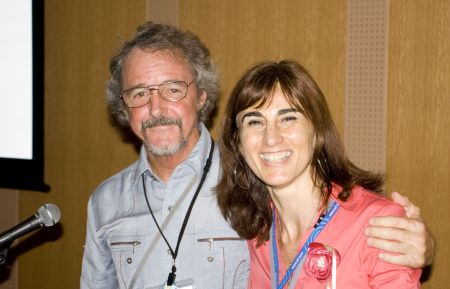
Nelba Quintana and I after we gave our presentation - photo by Joseph Dias
As mentioned, Nelba Quintana, one of the original Writingmatrix teachers, joined me at my session, and Rita Zeinstejer and Sasa Sirk joined in online, as you can hear in the recording.


Several Webheads (http://webheads.info) attended this conference. Some are shown in the photo above, taken by Tom Robb (also a Webhead). They might have been about to listen to Vera Menezes give an interesting plenary address on CALL development in the context of chaos theory and how strange attractors create butterfly effects impacting subsequent development of a field like CALL felt all around the world. For example ... imagine huge auditorium, huge screen dwarfing tiny podium with speaker on stage, who clicked on a slide on ... Webheads in Action, and another slide on Writingmatrix. Erika Cruvinel was also mentioned in one of Vera's slides where she talked about Erika's model project sharing with Claudia's class in La Plata. 

I found this picture at the Webheads Posterous blog which was moved (when Posterous shut down) here http://webheadsinfukuoka.wordpress.com/.

I wrote up my talk for the conference proceedings

Stevens, Vance. (2009 July 15). Engaging Collaborative Writing through Social Networking. In Koyama, Toshiko; Noguchi, Judy; Yoshinari,Yuichiro; and Iwasaki, Akio (Eds.). Proceedings of the WorldCALL 2008 Conference. The Japan Association for Language Education and Technology (LET). ISBN: 978-4-9904807-0-7, http://www.j-let.org/~wcf/proceedings/proceedings.pdf pp.68-71.

My paper Engaging Collaborative Writing through Social Networking appears in the online version of the WorldCALL 2008 proceedings http://www.j-let.org/~wcf/modules/tinyd12/index.php?id=5. The paper linked from those proceeds is available here http://www.j-let.org/~wcf/proceedings/d-052.pdf, while a proof version can be found here http://www.vancestevens.com/papers/archive/WorldCALL2008_proceedings_vancestevens.pdf) 


Tuesday, November 13, 2012

When is a MOOC not a MOOC?

 (What MOOC means to me)

I have to admit I would not be drawn to a blog post entitled so vacuously as, "what MOOC means to me"  (so I thought up something catchy and made the real purpose of this post its subtitle). However, it's early days for working out what MOOC means for anyone.  People have different ideas about what MOOC means, period.  Obviously, the most relevant meaning is the one that reaches any one of us personally.  MOOC means a lot to me, I'm going to try to pin down that meaning here, and maybe this will help you get your own grip on what MOOC might mean to you.


John Hibbs and I presented on the topic November 14, 2012, at the Global Education Conference (http://www.globaleducationconference.com/, which Steve Hargadon has pointed out, is a conference on global education, not an international conference particularly).  John has prepared a few documents on his own blog:
Here are our session artifacts:

MOOCs for ESOL and language learning

There are two thrusts to the presentation.  One is that an excellent audience for MOOCs might be in ESOL and language learning in general.  To my knowledge, this is indeed an avenue not particularly explored or developed as MOOC, though my own online credentials stem from what might be viewed as one of many precursors to MOOCs.  Dave Cormier takes credit in the "The True History of the MOOC" for invention of the term MOOC in the spring of 2008 (mp3 available, http://www.downes.ca/presentation/300).  He does point out that there have been many MOOC-like configurations for learning since the 19th century, but that the term MOOC to describe them began with his inspiration, which Leigh Blackall says (in A True(er) History of Moocs http://www.leighblackall.com/2012/10/a-trueer-history-of-moocs.html), that MOOC's emergence as a meme for universities and businesses, has become 'irritating'.  I have argued that we had MOOCs before 2008 as well, one example being http://study.com, which offered language lessons to all comers, and which spawned Writing for Webheads, which started leaving artifacts online in 1998 <http://prosites-vstevens.homestead.com/files/efi/webheads.htm>.  So regarding what MOOC means to me, one interest I have in it is as a platform for what we were doing in 1998, when we were experimenting with platforms for teaching people ESOL and other languages for free online.

It was around this time that I became aware of John Hibbs's work in the pre-MOOC era.  John had created a web page from which he launched a virtual ship each year to make a journey around the world hour by hour in 24 time zones <http://www.bfranklin.edu/gld8/gld8.htm>.  He had organized people in different parts of the world to manage the program for that region and in 1999 I was tapped by the Middle East organizer Neil Hynd to make a presentation of some kind.  I remember that the first one I did, I was patched into the stream through a POTS phone line, but in subsequent years John was using Real Player for streaming the audio, Though our team again presented in 2001 from Abu Dhabi using a POTS phone patch, we listened via Real Player. At the time this was impressive stuff, right on the cutting edge. John was one of the first pioneers of free (that was unusual!) online seminars of educators who could meet in real time through his web pages. John's effort stimulated me to do something similar in organizing three WiAOC's (Webheads in Action Online Convergence), each one a 3-day round the clock free all-volunteer online conference that I coordinated in 2005, 2007, and 2009 <http://wiaoc.org>.

Webheads in Action (WiA, http://webheads.info) came about in response to the fact that an emerging community of educators had started overwhelming the ESOL student voices in the original  Writing for Webheads community.  How this happened has been documented elsewhere (e.g. http://tinyurl.com/tacon2012L2g), but again as far as MOOCs are concerned, Webheads began focusing on teachers as opposed to students when it started giving EVO (Electronic Village Online, http://evosessions.pbworks.com) sessions in 2002, and the WiA community grew from there, to over a 1000 members today in just the Yahoo Group alone.  Again, this is not meant to be a description of WiA or EVO, but simply to suggest that if WiA and EVO are considered to be courses, and if 1000 members is massive, then they are definitely open and online, and had we started them 6 years after we did we might have called them MOOCs.  At the time we called them variously groups, communities, and networks (Stevens, 2009).

multiMOOC

Meanwhile I have been teaching a Multiliteracies course for EVO and the last couple of years I've been utilizing MOOC elements in the course at http://goodbyegutenberg.pbworks.com.  It's essential for such a course to have a framework. When I started the course in 2004 I patterned that framework on Stuart Selber's aspects of functional, critical, and rhetorical multiliteracies.  After attending WorldCALL in 2008 and meeting Mark Pegrum there, I divided the course into the lenses through which he viewed the topic in From Blogs to Bombs.  But as I learned more about MOOCs and experienced them more and more firsthand, in 2011 I started dividing the topics of the available five weeks into those suggested in Dave Cormier's viral videos explaining the 5 steps to Success in a MOOC: orient, declare, network, cluster, and focus (this link will point you to all the videos in the series: http://youtu.be/r8avYQ5ZqM0).  Now, in 2013, I have renamed the course Multiliteracies-MOOC (or multiMOOC for short) and Ana Cristina Pratas and I are going to run it even more overtly as a MOOC, as described in the proposal and rationale here: http://TinyURL.com/EVO2013MultiMOOC).  

In this course, the syllabus is just a suggestion (orient). Participants decide, each individually, what they want to accomplish in the course (declare). They network with one another to collaborate on shared goals, they produce what I call Me-Portfolios to reflect on how well they have accomplished their goals, and this next time around I hope to introduce some form of badging to help participants focus their goals and vis a vis their accomplishments in the course. In our last Learning2gether event, on Sunday November 11, Jonathan Finkelstein offered to help us envisage and realize that through the LearningTimes BadgeStack facility, http://learning2gether.posterous.com/jonathan-finkelstein-walks-us-through-learnin.

So what is a MOOC course then?

First of all I should point out there there are different kinds of MOOCs, and mine is just one of those kinds.  Lisa Lane has isolated at least three strains in the wild, as shown in this graphic from her blog post here: http://lisahistory.net/wordpress/2012/08/three-kinds-of-moocs/.


In this scheme, multiMOOC would straddle network and task-based. Many people these days would make that distinction in reference to cMOOCs and xMOOCs. The kind of MOOC that I am emulating is a cMOOC, a connectivist one, where the course facilitator lays out a cohesive structure for what is to be learned but, in Siemens's words, does not walk the path for the participants, expecting them to follow <http://youtu.be/VMfipxhT_Co>.  The facilitator instead encourages the participants to find their own pathways through the material.  What George actually says is transcribed in part here:
http://goodbyegutenberg.pbworks.com/w/page/48177073/GettingStarted2012evo

"I’m not aware of any research actually that says linear structure produces better outcomes than more chaotic meandering structure. Our intent, based on our theories of learning is to argue that the experience of learning, making sense of that chaos, is actually the heart of the learning experience, but if an instructor makes sense of that chaos for you and gives you all the readings and sets the full path in place for you then to a degree you are eviscerating the learner’s experience because now you’ve made sense of them and all you’ve told them is walk the path that I’ve formed. When it comes to complexity I’m a great fan of letting learner’s hack their way through that path and getting the value of that learning experience and that sense-making process.”

If the facilitator for whatever reason (too many participants, thinks it's better if s/he stands aside) gives the responsibility for sense-making to participants in a MOOC, then they might negotiate how to make sense of their syllabus with one another.  This is where the massive part of MOOC kicks in.  If the critical mass of participants is correct, then nuclear fission will occur in some people's brains, and they will be driven to blog and tag and comment on each other's posts, and leave reflections up as artifacts on the web. If the MOOC is run by Stephen Downes then it aggregates these posts through a script called gRSShopper <http://grsshopper.downes.ca/description.htm> and publishes them each day in a daily 'newsletter' generated from that aggregated content.  If the MOOC is run by me then we have to replace the word 'massive' in its acronym with something more appropriate to the scale of the venture, say, 'minuscule' for example.

In any event, this addresses the first issue of our presentation, the appropriateness of MOOCs to teaching ESOL and other languages.  Also the kind of MOOC best suited to a communicative and socially-driven endeavor such as language-learning is cMOOC, based on the concept as initiated by Siemens and Downes, with Cormier's contribution of the just-so acronym. As for why anyone would want to run such a course, the Internet is full of sites already where language teachers are competing with one another to share their knowledge with students in the most clever way possible, for free. Stephen Downes was once asked why he would flog himself across the back with a course open to thousands (of course, they didn't know at the time it would attract so many :-) when he could have left it at just the two dozen enrolled in the course at the college, and he replied simply, because he would learn from it.  This is the prime motivator for setting up a cMOOC.

xMOOC vs cMOOC

I thought* George Siemens (2012) had coined the term xMOOC when he added a tentative ? to his remarks about "the well-financed MOOCs by Coursera and edX (xMOOCS?)."  While taking pains to explain that feedback on xMOOCs suggested they were effective in achieving  their purposes, he went on to explain: 
Our MOOC model emphasizes creation, creativity, autonomy, and social networked learning. The Coursera model emphasizes a more traditional learning approach through video presentations and short quizzes and testing. Put another way, cMOOCs focus on knowledge creation and generation whereas xMOOCs focus on knowledge duplication.

(* However Stephen Downes takes credit for that distinction at 61 minutes into this recording: http://youtu.be/DGaUfWkJdi4)
This brings us to the second brunt of John's post, the second thrust of our presentation, and this is that MOOCs, and by this John means xMOOCs, as conceived by Coursera and Mechanical MOOC, might damage hard-earned university branding.  John and I have both enrolled in such courses.  I have experienced the very humanistic gentle reminders and suggestions issued by Mechanical MOOC, http://www.i-programmer.info/news/150-training-a-education/4684-mechanical-mooc-offers-introductory-python-.html, almost as if there was a human there, while John can (and will in the presentation) document very different experiences of frustration with Coursera. John's contention is that in their rush to sign on with mechanical courseware generators, universities might be weakening the quality of their offerings until the purveyors of such courses can improve their quality to the standard of instruction expected from those institutions.  Though written to a different topic, Siemens's quotable "there's no there there" springs to mind from the anecdotal evidence that John reports (Siemens's quotable article: http://www.elearnspace.org/blog/2011/07/30/losing-interest-in-social-media-there-is-no-there-there/).

John's is not a voice in the wilderness. Mike James in an article in I Programmer says that "the methods used by the hugely successful courses are little changed from the dark ages" http://www.i-programmer.info/professional-programmer/i-programmer/4494-massive-open-online-courses-fail-students-with-dark-age-methods.html.  James refers to Sebastian Thun's co-professor in the Stanford AI course, Peter Norvig, who had made reference to the dark ages in his TED Talk on the AI MOOC, http://www.i-programmer.info/news/150-training-a-education/4398-peter-norvig-on-the-100000-student-classroom.html.

But this article is about what MOOC means to me (to me it means "cMOOC").  However, the extrapolation of the MOOC concept to xMOOC is I think part of what is irritating both John Hibbs and Leigh Blackall.  When Sebastian Thun took the MOOC concept to the point where he demonstrated that he could not only teach Artificial Intelligence in a MOOC, and scale that to thousands of comers, AND assess and evaluate those participants through algorithms developed by Amazon, the proof of concept he had shown was xMOOC.  Thun proved the concept so well that he decided his tenured position at Stanford was beneath him and left there to work for Google and ended up with his own xMOOC, Udacity, (http://www.guardian.co.uk/education/2012/nov/11/online-free-learning-end-of-university).  Thun is fully convinced that he made the right move, and he might be recognized as a visionary for it, and like Stephen Downes he will surely learn from the experience, but the motivation for this effort is more toward the flip side of education from that of cMOOC.  Whereas one obvious limitation of cMOOC is that participants need to be highly motivated self-starters who are driven to learn about a particular topic, xMOOC is addressed more at the masses, the hoards of students for whom expensive Ivy League education (or increasingly, even community college education) is less and less an option.  Candace Thille, director of the OLI at Carnegie Mellon University, worries that this development might lead to a "bifurcation" in educational opportunities in the not-that-distant future, http://www.insidehighered.com/news/2012/05/10/candace-thille-talks-moocs-and-machine-learning.

Given the downward spiral in the world's economies and shortage of resources, abundance is a word more and more applied to knowledge resources than to natural and manufactured ones, which are approaching scarcity.  Where the ascendancy of knowledge abundance intersects with the increasing lack of natural and economic resources, xMOOCs may well be the most viable path of quality education for learners of the future. John's point has to do with the present state of the quality of THAT instruction, and how that might impact branding of universities associated with the current xMOOC players.

When is a MOOC not a MOOC?

So as not to get off on a semantic battle, technically, a MOOC is a MOOC if it has lots of participants, if it's open to anyone, which means for free (otherwise it wouldn't be open), if it's online, and if it's a course. All of the sites mentioned in this post are MOOCs in that broad definition.

So my conclusion applies to the spirit of MOOC, what I in my heart of hearts feel is MOOC in its pure form.

If I were to conceive of a diagram giving the whole spectrum of MOOC from the 19th century (as Cormier mentions) up through the 20th (with http://study.com and Writing for Webheads) and into the turn of the century (where for example EVO started teaching open courses massively online) - then I would put those early efforts off to the left and place cMOOC as conceived in 2008 squarely in the center, with the current evolution of xMOOCs veering off to the right and into the future.

I would say that open online courses we used to organize and try to scale massively predated a window of opportunity for social networking and aggregation of content that the cMOOCs slotted nicely into.  And I would say that these early efforts depart from what I think of as truly MOOC about as equally as do the later renditions, which though technically massive, open, online, and courses lack a lot of the flavor of the middle-cMOOCs by virtue of not having well developed the connectivist aspects of the 2008 model.

MOOCs in the future: A return to center?

Stephen Downes thinks that MOOCs must evolve in a return to their roots.  He illustrates this for us in a sketch in the Bb Collaborate / Elluminate version of the True History of MOOC (shown in this screen shot from
https://sas.elluminate.com/p.jnlp?psid=2012-09-26.0742.M.9E9FE58134BE68C3B413F24B3586CF.vcr&sid=2008350).

The sketch began with MOOCs in the middle and with the entities at the end of each line setting up free open online courses but monetizing some aspect in the form of accreditation, help facilities, etc.  The circle around MOOC indicates that MOOCs utilize OER (open education resources) and the "open web of content" as illustrated in the diagram Stephen inserted and then relegated to the top left corner. Then Steve Hargadon asked in the discussion if these entities (the new xMOOCs) were paying tribute to their roots in cMOOC.  Stephen said off the top of his head, "no" but did note that in something he had come across lately, it was found that the biggest predictor of success at Harvard (apart from getting into Harvard) was participation in study groups.  As others commented, Stephen proceeded to wipe the MOOC from the center of his diagram and put in xMOOC with study groups forming around any given xMOOC.

Stephen then explained, for xMOOC to be truly viable, it will inevitably have to move in the direction of cMOOC.  In his words, “The connectivism model will become the primary model … [xMOOCs] have to grow to become cMOOCS ... They will do that over time." You heard it first there, read it first here :-)

Referenced websites

Blackall, Leigh. (2012). A true(er) history of MOOCs. Open and Networked Learning. Retrieved on November 15, 2012 from http://www.leighblackall.com/2012/10/a-trueer-history-of-moocs.html.

Downes, Stephen. (2012). A true history of the MOOC. Stephen's Web. Retrieved on November 15, 2012 from http://www.downes.ca/presentation/300.

Hargadon, Steve. (2012). Tonight - A true history of the MOOC. Education, technology, social media, and you! Retrieved on November 15, 2012 from http://www.stevehargadon.com/2012/09/tonight-true-history-of-mooc.html.

Hibbs, John. (2012). MOOCs Global Education Conference Presentation. Ben Franklin. Retrieved on November 15, 2012 from http://oregonhibbs.com/2012/10/29/moocs-global-ed-conference-presentation/

Hibbs, John. (2012). MOOCs For Credit – Coursera & Antioch. Ben Franklin. Retrieved on November 15, 2012 from http://oregonhibbs.com/2012/10/30/moocs-for-credit-coursera-antioch/.

Hibbs, John. (2012). Crown Jewels, 21st Century Diploma Mills, MOOCs on the Moon. Ben Franklin. Retrieved on November 15, 2012 from http://oregonhibbs.com/2012/11/13/crown-jewels-21st-century-diploma-mills/

Hibbs, John. (2012). Global conference Hibbs prepared remarks. Ben Franklin. Retrieved on November 15, 2012 from http://oregonhibbs.com/2012/11/14/global-conference-hibbs-prepared-remarks/#more-682.

James, Mike. (2012). MOOCs Fail Students With Dark Age Methods. I Programmer. Retrieved on November 15, 2012 from http://www.i-programmer.info/professional-programmer/i-programmer/4494-massive-open-online-courses-fail-students-with-dark-age-methods.html.

James, Mike. (2012). Peter Norvig On The 100,000-Student Classroom. I Programmer. Retrieved on November 15, 2012 from http://www.i-programmer.info/news/150-training-a-education/4398-peter-norvig-on-the-100000-student-classroom.html.

Kolowich, Steve. (2012). MOOCs and Machines. Inside Higher Ed. Retrieved on November 15, 2012 from http://www.insidehighered.com/news/2012/05/10/candace-thille-talks-moocs-and-machine-learning.

Lane, Lisa. (2012). Lisa's (Online) Teaching Blog. Retrieved on November 15, 2012 from http://lisahistory.net/wordpress/2012/08/three-kinds-of-moocs/.

Pegrum, Mark. (2009). From Blogs to Bombs: The Future of Digital Technologies in Education. UWA Publishing, Crawley, Western Australia.

Selber, Stuart. (2004). Multiliteracies for a digital age. Carbondale: Southern Illinois University Press.

Siemens, George. (2012). MOOCs are really a platform. Elearnspace. http://www.elearnspace.org/blog/2012/07/25/moocs-are-really-a-platform/

Stevens, Vance. (2009). Modeling Social Media in Groups, Communities, and Networks. TESL-EJ, Volume 13, Number 3: http://www.tesl-ej.org/wordpress/past-issues/volume13/ej51/ej51int/.

Stevens, Vance. (forthcoming). Learning2gether: Wiki-based worldwide teacher professional development Paper presented at the annual TESOL Arabia conference in Dubai, March 9, 2012. Submitted for publication in the proceeds. Version available online: http://tinyurl.com/tacon2012L2g.

Tracey, Ryan. (2012). The future of MOOCs. E-learning Provocateur. http://ryan2point0.wordpress.com/2012/11/26/the-future-of-moocs/


Saturday, March 17, 2012

DIYLMS: Do-it-yourself learning management systems

It's been a while since I've posted here, but meanwhile I've been laying tracks in other spaces around the Web. I still consider this to be my central blog where I try to record my most introspective thoughts on social media assisted learning but I've been posting my most recent writings in other blogs and wikis.

I've just returned from a stint of edutourism in Morocco and Turkey, interspersed with two presentations at TESOL Arabia in Dubai, and I'm leaving shortly for Philadelphia where I'm due to give yet another presentation, followed by another in Sharjah April 3, and then a final one scheduled for Taichung in May, before I finish my teaching and take a break for the summer.

The talk in Taichung is a co-presentation with Aiden Yeh on "Thinking SMALL: Facilitating online teacher professional development" and is along the lines of a book chapter I had promised to produce last summer, before losing my previous job and finding myself up against a wall, which I've now managed to climb and scramble over.  In the process of finding a way over that wall, the book chapter fell by the wayside.

As a part of that protracted scramble I took on a part-time teaching job with New York Institute of Technology in Abu Dhabi teaching research writing to expat and local UAE students at NYIT. I was given a syllabus to cover but was left to my own devices as to how I would realize it, so I created a wiki with links to online versions of all the course materials at http://fcwr101.pbworks.com/ and got students to submit their work primarily in Google Docs.  When I finally got a full-time job with the Higher Colleges of Technology Abu Dhabi Men's College, CERT, I carried over what I had learned working with student writers at NYIT to my new posting teaching academic composition via yet another wiki, this time tailor-made for cadets at the UAE Naval College. Here I employed similar techniques as at NYIT, taking submissions in Google Docs and organizing the course with links to syllabus materials, screencast tutorials, and other course resources at another wiki made for that purpose,  http://academiccomposition.pbworks.com/.

I felt more comfortable with constructing courses in this way than I did using Moodle (as I'd been doing in my previous teaching position at The Petroleum Institute,  http://www.pimoodle.org/course/category.php?id=9, guest access allowed). My realization that a wiki-based environment could do much and more of what I had accomplished with Moodle led me to coin a concept I dubbed DIYLMS, do-it-yourself learning management systems.  When I was invited to go to Marrakech as guest of the IATEFL Learning Technologies Special Interest Group (LT-SIG) and MATE (Moroccan Associate of Teachers of English) to give the keynote speech at a conference there, I suggested DIYLMS as a topic.  This was fine with them, my talk was very well received, and I archived the event with recordings and other image artifacts at one of my Posterous blog spaces, since moved to http://advanceducation.blogspot.com.au/2013/04/learner-centered-do-it-yourself.html

Here are the slides from that keynote:
I had already written a rationale for the DIYLMS concept as a link from the course at NYIT http://fcwr101.pbworks.com/DIYLMS but I expanded this into its own wiki when I was asked to help with a pre-conference development course in Dubai the day before the official start of the 2012 TESOL Arabia Conference at the HCT Dubai Women's College. The professional development course was entitled "Online Teaching and Learning in TESOL", and I followed fellow-presenters Nicky Hockly and Justin Shewell to give my workshop on DIYLMS.  True to form, I created a wiki as a portal for the workshop and gave a hands-on follow up to the rationale I'd laid down in Marrakech.  The wiki portal is here: http://diylms.pbworks.com/ and the slides are below:
DIYLMS = Do it yourself Learning Management Systems, Part 2 the Workshop
View more PowerPoint from Vance Stevens

This event took place just before a deadline I was supposed to meet as editor of the On the Internet column in the TESL-EJ journal, so I drafted an article explaining the components of DIYLMS and posted it to its own blog which I'd created in case any participants wanted to subscribe and experience firsthand the particular affordances of Posterous as a tool in DIYLMS:
http://diylms.posterous.com/ (Posterous shut down at the end of April 2013; the post has since moved to http://advanceducation.blogspot.com.au/2013/04/learner-centered-do-it-yourself.html).  All of this was meant to model for participants at the TESOL Arabia workshop how a DIYLMS might be constructed and convey something of its look and feel to those who participated in the workshop. The TESL-EJ version has since been published as:

Stevens, Vance. (2012). Learner-centered Do-it-yourself Learning Management Systems. TESL-EJ, Volume 15, Number 4, pp. 1-14: http://tesl-ej.org/pdf/ej60/int.pdf. Also at http://www.tesl-ej.org/wordpress/issues/volume15/ej60/ej60int/

Meanwhile I was invited to travel to Turkey as guest of Erzincan University to give seminars to their students and teachers March 13 and 14, 2012.   Details were ironed out at the last minute, and I was not given adequate notice to prepare handouts for the students, so again I used the tried and true techniques of working from a wiki which I created for the occasion: http://erzincancalling.pbworks.com/.  Again my intent was to teach through demonstrating and modeling how learning can accrue from appropriately configured use of social media-enabled Web 2.0 tools.

The workshop was a challenge because it was given to four dozen participants sitting at as many computers arranged in rows set perpendicular to the front of the room, so those in the back of the room were for all intents and purposes distance learners.  I reached into my hat and pulled out one rabbit after another in an attempt to attract the students to spaces we could all cohabitate online.  At some point, one of the brighter students asked the correct question; essentially, how does this all hang together and what does it have to do with learning English?

In answer to that I got the students to crowd-source sites they were using for learning English in TitanPad, one of the more robust Etherpad clones, and had just pasted their contributions into a Google Doc when the workshop abruptly ended with the students simultaneously exhibiting signs of not wanting to miss lunch, but not before they had almost all registered in the Google Doc I had just created for them as the next step in their interactive learning process.

I was at that point only midstream in where I was trying to take them but I realized I had a powerful tool in that they were all registered in this one Google Doc, so I registered their teachers there as well, and began imagining that this could potentially be just the start of an extended blended learning journey, if the students wanted to carry on where we'd left off through use of the tools I had just put in place for them.

Meanwhile one of my Facebook friends had been asking if anyone could contribute an article needed right away for a journal in Serbia, so I agreed to write up my observations as further explanation to the students and teachers in Erzincan of what we had started together, and I invited my Serbian colleagues to publish it if they wished.  That writeup has been moved here: http://advanceducation.blogspot.com.au/2013/04/turning-3-hour-face-to-face-seminar.html

I'm due to trot all this out once again April 3rd at the 6th eLearning in Action conference at the Sharjah Higher Colleges of Technology:  http://194.170.54.16/events/edtechpd2012/index.asp, which I hope to simulcast in Blackboard / Collaborate (Elluminate).  If you can stand more, stay tuned :-)

I hope to add here links to that recording, as well as links to my TESL-EJ article and to the one for the Serbian journal, both of which I think should be published soon.


Tuesday, May 3, 2011

How cognitive surplus drives us to helping one another

Why am I taking my time to write this?  I discovered the other day that it has something to do with Josh Groban, a ‘popera’  singer who Clay Shirky, in his book Cognitive Surplus, says appeals to teenage girls and their grandmothers.  I had never heard of Josh Groban nor imagined that I could possibly have anything at all in common with him.  His entry in Wikipedia doesn’t mention Grobanites (yet), but Shirky dwells mostly on these Grobania fans who have banded together to raise money for Groban’s charities.  Intriguingly, they have a lot in common with Webheads.

The Grobanites are young fans of Groban’s who met through the community on Josh Groban’s website http://www.joshgroban.com/ and at some point tried to decide what to get Josh for his birthday.  After rejecting teddy bears and other fluff, they decided to collect money and give it to one of his charities.  The first year they raised a thousand dollars, the next a magnitude amount higher, and by now they have raised over a million dollars for Josh Groban charities.
Shirky puts this into perspective.  When you donate to a charity there is usually an overhead associated with running the charity, so that  only some fraction of what you give actually reaches the beneficiaries. It’s considered acceptable if a charity retains 40% in overhead, whereas holding back only15% for administration is excellent. With Grobanites, 100% reaches the beneficiaries.

This is because they are all volunteers.  The webmaster is a volunteer; accordingly, the website is a little funky, homegrown, but friendly: http://www.grobanitesforcharity.org/.  Shirky talks about Geocities, one of the first online hosts that allowed just anyone to create web pages, and how at the time he thought Geocities would fail because those web pages were going to pale next to what professionals could do, but Shirky says he was proven wrong.  He had not factored in the heart and passion and the spirit that causes amateurs (in the etymological sense) to care more about having their say than about how their web presence online stacks up against slick professional look and feel (Webheads also utilized Geocities until the site shut down, and its exstant Web 1.0 sites retain that same look and feel).

Shirky goes on to detail how home-cooked websites invite sharing and interaction. This is exactly what we have inadvertently achieved with http://webheads.info, or as an example of 'class roots' modeling and interaction, what we are trying to inspire with http://learning2gether.pbworks.com.
Shirky analyzes such spirited initiatives.  He cites research on motivation, e.g. seminal work by Edward Deci (1972), who gave students Soma-cube puzzles to solve and then left the room to take a break.  There were distractions lying around the room, Playboy and other magazines, so the experiment was to actually to see what the students would do during the experimental treatment, the 8 minute break.  On average, they were intrinsically motivated to spend a few minutes of their free time working on the puzzles.

Permission to use granted under creative commons license; attribution: http://fr.fotopedia.com/items/flickr-3661361368

Then he ran the experiment again, but this time he paid some of the subjects for each shape they were able to create.  During the break he observed that those who were paid spent a minute more of their break time working the puzzles than before, since they now saw this skill as a source of income, whereas those who had no money involvement behaved pretty much as before.  Then he ran the experiment a third time, with the same subjects, without offering to pay for puzzles completed, and he discovered that during the break those he had paid spent on average 2 minutes less of their free time exploring the cubes.  In other words, the introduction of the extrinsic motivator, money, had suppressed free choice and “crowded out” the intrinsic motivator.
Shirky concludes: “Doing something because it interests you makes it a different kind of activity than doing it because you are reaping an external reward.” This research and others with similar findings overturned the intuitive assumption that you get what you pay for, that putting money into a mix would increase the incentive for people to engage in a given behavior.  Deci’s research suggested that this worked only as long as the extrinsic  incentive was there, but if that was withdrawn then the desire to do it intrinsically was “crowded out” resulting in a reduction of motivation to do the task at all, or as Shirky puts it: “increasing extrinsic motivations can actually decrease intrinsic ones.”
Grobanites and Webheads on the other hand work entirely on intrinsic motivation.  Shirky says there are three reasons people engage in such efforts.  First, they crave the autonomy.  Second they want to be perceived as competent.  And third, they want to feel connected. Furthermore, the desire to contribute to society and to help others is also a motivator.  Shirky cites another experiment where people in a town in Switzerland were asked if they would accept a hazardous waste dump in their precinct.  The request was couched in two ways.  For both groups a reason was given why the town had been selected for this, but in one form of the request, it was stipulated that the town would be paid for accepting the wastes.  Of course there was opposition, but the acceptance rate  was significantly higher when the request was made appealing to civic duty rather than when money was used as the carrot.
So money is not necessarily the most powerful stimulus for producing change for the better. People will volunteer to do good when they feel they are acting autonomously and when they will be seen to be competent at what they do.  The third reason, the connected aspect, is the one that Shirky particularly explores in his books. Previously when connecting was hard to do, it was hard for charitable ideas to scale.  It was possible last century for volunteer donors to work through a church group, for example, but if you wanted to organize 100 churches, you needed to hire a manager, an accountant, a publicist, etc. and incur overhead.  But with Grobanites and Webheads, the tools are now available for people with purely altruistic agendas to promote their niche interests voluntarily and scale those interests to reach thousands of others without needing to resort to extrinsic motivators such as money.
Shirky cites work by Yochai Benkler and Helen Nissenbaum to help explain how this works. Benkler and Nissenbaum (2006) write about “commons-based peer production" in which they discuss how the social motivations of connectedness or membership, and sharing and generosity, support the personal motivators of autonomy and competence. Shirky says: “The motivation to share is the driver; technology is just the enabler. This feedback loop of personal and social motivations applies to most uses of cognitive surplus, from Wikipedia to PickupPal to Grobanites for Charity.  Grobanite donors and supporters get two messages: both I did it and We did it.”

All this is precisely what drives Webheads, an amateur movement of educators with accumulated cognitive surplus who truly enjoy helping one another, and benefit from being helped in the bargain. As Benkler and Nissenbaum suggest, Webheads have a strong feeling of belonging, of membership in a group with a funky name "webheads". The group's members are overflowing with sharing and generosity, as is evidenced time and again in their thousands of messages posted at http://groups.yahoo.com/group/evonline2002_webheads. This leads many of us in this group to realize what Sir Ken Robinson calls our element, "the place where natural aptitude and personal passion meet," and to define our epiphanal aha! moments.


This leads into Shirky’s chapter on "Amateur Motivation, Public Scale", which begins “Amateurs are sometimes separated from professionals by skill, but always by motivation … Keeping a large group focused can be a full-time job ... Organizing groups into an effective whole is so brutally difficult that, past a certain scale, it requires professional management … salaries … bookkeeping and all the rest of the trappings of a formal organization ... As always, high hurdles to an activity reduce the number of people who do it, and the hurdle of large-scale coordination has largely separated amateurs from professionals ... when pursuing an intrinsic goal in public required considerable work, the amateurs largely opted out of public action. We have always wanted to be autonomous, competent, and connected; it’s just that now social media has become an environment for enacting those desires rather than suppressing them
"… Back when coordinating group action was hard, most amateur groups stayed small and informal. Now  that we have tools that let groups of people find one another and share their thoughts and actions, we are seeing a strange new hybrid: large, public, amateur groups. Individuals can make their interests public more easily, and groups can balance amateur motivation, and large coordinated action more easily as well.
“Globalization isn’t necessarily about size; it’s about scope. Now that the difficulty of coordinating interactions has fallen, it is entirely possible to have a tiny global organization. Geography still matters, but it is no longer the main determinant of participation.”
These ideas are echoed in Lawrence Lessig's book Remix (2008), available now as a free eBook: http://www.archive.org/details/LawrenceLessigRemix. Lessig talks about two distinct economies, commercial and sharing. Purely sharing economies thrive on just the dynamics that Shirky describes; i.e. a set of social values where members are essentially paid for their surplus time in recognition for competence and generosity. Lessig also discusses what he calls hybrids, or ventures that incorporate vestiges of both economies. Whereas there have been some ventures that have succeeded in going from commercial to sharing and visa versa, Lessig cites many more instances in which this has proven impossible. Some of the studies cited by Shirky, notably Deci's, give crucial insights into why this is so.  If projects are started as sharing ventures, attempts to monetize them simply suppress the motivations that gave them their traction.
So why am I writing this?  For the three reasons noted,  I am intrinsically motivated to do so even though my extrinsic motivators are telling me that I’d better get working on things more relevant to my paycheck.  And why do participants in a large community of Webheads invest so much of their cognitive surplus in joining me in sharing with one another?  Because, as with Grobinites, there’s no money involved.  They have not come to see the good they do as being a part of the money economy.
Now why did I know all that instinctively? Why do so many others pursue the same altruistic goals without demanding the most obvious extrinsic compensations? Because it's the natural thing that humans have always tried to do for one another. Shirky, Lessig, and others are just, after all this time, telling us why we do it, and why in our connected era, it is now possible to help one another on the scale on which we can now help one another by putting into play our inherent intrinsic motivators.

Notes:


References

Benkler, Y. and Nissenbaum, H. (2006). Commons-based peer production and virtue. The Journal of Political Philosophy 14, 4: 394-419. Retrieved May 1, 2011 from http://www.nyu.edu/projects/nissenbaum/papers/jopp_235.pdf

Deci, E. (1972). The effects of contingent and noncontingent rewards and controls on intrinsic motivation. Organizational Behavior and Human Performance 8, 2:217-229; Received 23 September 1971.
Available online 26 August 2004, doi:10.1016/0030-5073(72)90047-5 (Elsevier Inc.) More info here

Lessig, L. (2008). Remix: Making art and commerce thrive in the hybrid economy. New York: The Penguin Press. Available as eBook from http://www.archive.org/details/LawrenceLessigRemix.

Robinson, K. (2009). The element: How finding your passion changes everything. New York: Viking Penguin.

Shirky, Clay. (2010). Cognitive Surplus: Creativity and Generosity in a Connected Age. New York: The Penguin Press.


This post has a TinyURL: http://tinyurl.com/advanced-cogsurplus

Thursday, March 10, 2011

Transforming learning with creative technogogy: Achieving the aha! moment

In starting this article about the interplay between technology and pedagogy, I wanted a term to combine the two whereby pedagogy would come first.  I googled 'pedagology' and got no hits.  Great, I thought I had coined just the term ... until I realized there is a term andragology, meaning the study of the science of andragogy.  Therefore, pedagology would logically be the study of the science of pedagogy, so I tried the term in reverse.

When I found that the reverse-term 'technogogy' got 22,000 hits, I realized I'd come across the word before. There are many blogs containing that term, and many of the hits are related to ELT, for example Nik Peachey's Web page at http://www.technogogy.org.uk/. There is a posting by Zaid Ali Alsagoff (well known for his blog on Web 2.0 resources: http://zaidlearn.blogspot.com/) defining technogogy as "the convergence of technology, pedagogy and content in the transformative use of technology to foster learning," http://elearningmalaysia.blogspot.com/2008/01/technogogy-convergence-of-content.html.

Zaid has added here the notion of 'content' to otherwise the same definition in the first paper he is aware of on Technogogy, a keynote cited as Idrus, R.M. (2005). “From Facilitation to the Transformation of Learning: From Pedagogy to Technogogy,” from the 5th International Educational Technology Conference (IETC2005) in Sakarya, Turkey (see the correct link in Idrus and McComas, 2006).

It's not surprising that ELT practitioners should be in the lead on co-opting a term such as technogogy, but I still find it remarkable that I can have all this information at my fingertips before I'm but halfway through my first cup of coffee in the morning.  It's not at all remarkable to be using Google, even though it does make possible access to knowledge that when I was younger would have required hours of tedious research through card catalogs and Reader's Guides available only by going physically to a brick and mortar library across campus or across town.  More remarkable still is that the library gave us access only to works that had made it through a publisher as arbiter of what we can find in the library; yet the Internet gives us access to a lot of that plus the extended knowledge of anyone with the wherewithal to post to a blog or wiki.  And it's not as Andrew Keen (2007) would have us believe, that this exposes us to a lot of "amateur" drivel ... well perhaps it does, but then publishers let in a lot of drivel as well, but theirs isn't subject to the scrutiny of anyone with the wherewithal to leave a comment, and in aggregate, it's that free-for-all crowd sourcing of opinion that gives the blogosphere its edge in currency and credibility. 

This is what Howard Reingold, in his list of 5 crucial new literacies skills, calls 'network awareness' (Rowell, 2010). It's access to that network of advice and opinion, trusted because it's vetted by peers who comment, that is the truly remarkable aspect of what you can find on the Internet.  And yet you still hear (or I do) very knowledgeable people, professors, remark that computers are isolating, when undoubtedly the opposite is true.  It's because computers are anything but isolating, because they bring people together in innumerable modalities, that they are transformative in learning.  Yet this is not widely accepted as fact due to the ineffable nature of the process.  Technogogy has to be experienced to be understood, and many simply do not grant themselves the opportunity to experience it; therefore they never achieve that aha! moment.

It's widely noted that there is lack of transfer between the social networking people do in their private lives and that which they apply to their professional environments.  Therefore, use of Facebook, for example, to track friends and relatives and share photos and pithy observations is not necessarily to experience social networking in a transformative way for learning (though it is certainly transformative in the way people deal with relationships nowadays -- breaking up is much harder to do when you have to update your status, redefine your friends and friends of your ex-friend, and cull through your photos posted online ;-).  It's often the case that people who delve into social networks for buying books online, shopping at eBay, couch surfing, or finding apartments and good restaurants do not transfer these social networking skills into their professional spaces.  This ability to transfer social networking skills from social to professional settings is just one of 10 paradigm shifts required of educators noted in Stevens (2010, see the revised version online, as presented in Slide 3, June 10, 2010: http://www.slideshare.net/vances/shifting-sands-shifting-paradigms).  

People who expose themselves to Web 2.0 technologies generally want to learn more about them, but those who do not blog, or use Google Docs, or bookmark with Delicious (to give a few entry-level examples) often cannot fathom what the fuss is about.  Their ways of doing things seem perfectly fine to them, and if they are teachers, their students have been doing very well for years with the tried and true techniques, thank you very much. Teachers who don't buy into social media or use it to any great extent for their own learning can hardly be expected to model its use for their students. 

Many students (and their teachers) in my own face-to-face workplace tell me don't feel they need Google Docs when they can share flash drives and email attachments.  They don't need Delicious when they can bookmark in their browsers on their own computers (remember when organizing and sharing those bookmark files was our sole means of social bookmarking?).  They don't see the value in blogs, resist blogging themselves, and don't see why they should refer to others' blogs to leverage their own learning. Because they tend to be not predisposed to utilizing social media with each other, let alone with students, it follows that proponents of the use of transformative technologies in education are often preaching to the choir, to one another via their PLNs, or personal learning networks, and only those who have experienced the affordances of transformative networked learning firsthand can really understand what the benefits are. 

These technologies only become transformative when their use becomes second-nature to the point where we and those around us use them in our normal workflow. When that happens, ways of thinking and doing change in dramatic ways.  When the culture of an institute or network of peers changes significantly in such a way that what was once merely desirable is not only possible but opens new possibilities, this is transformative.  Having had one aha! moment, users of transformative technologies tend to have another, then another.  Doors open to other doors, and then things become possible that were concealed behind doors which were obscured by other closed doors before.  Insights occur to those who have been through those doors that can't occur to those who have not opened even the first doors to see what is on the other side.  Once the doors are wide open, imagination is freed, creativity is given fertile ground in which to thrive.  Leaps are taken and then more leaps, and the connection with those left behind is sometimes lost as those who are delving into new technologies absorb more of the new cultures and make more and more connections that those who have not experienced those aha! moments are at a loss to understand.

Thus the real loss to an institute when Web 2.0 and other educational technologies are not encouraged is the potential for creativity.  This is a loss that cannot be measured because it would be a measure of what would have happened 'if only.'  Transformative creativity cannot occur in an institution where professional development is driven top down and limited to the ideas of people only within the confines of the institute, and often only to those with power to push their agendas.  It thrives in an environment where conversations among stakeholders are to some extent socially networked, held in open spaces where everyone has a voice.  Transformative development occurs within communities of practitioners intrinsically motivated to open doors and discover what lies beyond the doors they find on the other side, who have access to common spaces where they can share stories about their learning journeys.

In a recorded 15-minute multimedia keynote, Shelly Terrel says “when we want to transform education we have to share our stories and show how we became the innovative, passionate, motivated teachers we are today.” She acknowledges that we are not all like this, that many of our peers need encouragement, but that sharing stories is key to transforming education to the point where we break out of existing cycles: 
http://teacherbootcamp.edublogs.org/2011/03/04/considering-the-curriculm-teachmeet-newcastle-keynote/

There should be no teacher left behind, but those still in the "cycle" that Terrel decries often don't know where to begin to bridge that gap. Colleagues in this situation often tell me they would like to bridge it, but feel hesitant to make those leaps. They feel vulnerable in social networking systems that frankly, few of us fully understand, or worse, leave newcomers exposed to failure and ridicule. Often overworked teachers argue that they don't have time, that they need training (when what they need to know can be found readily online, along with communities of like-minded-peers eager to help them).  They might rationalize that the leap really isn't necessary anyway. They don't see the need for it because those who have moved through multiple doors to the other side seem so far out of touch with the 'real world' left behind.

Whether this is a problem for those who incorporate educational technology in their teaching or for those who do not depends on who is controlling the paths to the doors of discovery.  If those in control are progressive, there is impetus for everyone to move ahead, and those most progressive will put in place scaffolding to help the ones who wish to learn and develop.  But if those in control have not experienced themselves the affordances of new technologies that facilitate social learning, then they might cling to the status quo and find it against their vested interests to encourage progressive use of those technologies, and those who attempt to use them anyway might find little sympathy or cooperation from their immediate peers.  Lacking support from their immediate workplace, advocates of teaching through technology will experience frustration unless they connect with like-minded educators in the world at large, as many do!.

How can these two worlds be bridged?  How can teachers who are making transformative use of technogogy in teaching reach those who need assistance in understanding how to at least learn about the potentials for professional development and appropriate uses with students? Of course this is happening as we speak.  The gap is narrowing, more people are making the leaps required.  As Elizabeth Hanson-Smith used to say, in case anyone doubted this trend, "there will always be more technology" (personal communication with anyone who happened to be in hearing distance).

Resistance to advances in technology in education are not unique to this century. When I was involved in setting up a language department in Oman in the mid 1980's we allowed newly-hired teachers to choose whether to have on their desks a typewriter or a computer with WordStar, a word processor popular at the time.  Many chose typewriters, though those vanished rapidly over the next few years.  Of course, word processors were revolutionizing writing, not only in terms of speed, ease of revision and correction, and variety of text genres that an individual could produce, but how writing was taught as well. At those times there were teachers who clung to the notion that students should write out each revision of each paper they were working on, something to do with penmanship.  I argued at the time that it was hypocritical to be teaching a process of writing that those teachers themselves were no longer using.

Change comes slowly, and is facilitated through constant and patient modeling by those who are incorporating new technologies in their own working lives. Terry Freedman made a good presentation on change agency for the first K-12 Online conference (Freedman, 2006), and Kim Cofino has produced excellent posts on affecting change when administration is fully behind the process (e.g. Cofino, 2008).  Other presentations archived at the K12 Online conference web site include inspiring examples of how schools can transform their learning environment through embracing Web 2.0 and encouraging its use by students and teachers, and throughout the community at large (Carozza, 2009; Curtis, 2009).

More such examples abound in conversations in the podosphere. For example, in the episode of 21st Century Learning found at http://edtechtalk.com/ETT21_148 you can hear Peter Smith, head of the Middle School at St Andrews School in Savanah Ga., explain how the school recently underwent accreditation and were told they needed to upgrade their technology, so they gave iPads out to students and teachers, on the understanding that everyone would document their discoveries in open forum spaces. The process that allowed students and teachers to evolve how the devices would be used is an excellent example of how a learning community institutionalizes tranformative learning.

The iPad rollout was transformative because it avoided the top-down model of change agency.  Results would likely have been different had teachers been introduced to iPads in a presentation by management staff, given a one-off workshop, and told they had better start using them if they wanted to keep their jobs. Instead they were given the opportunity over time to model best practices and learn from one another.  Only by going through an experiential learning process can the ineffable be shared.

Twitter is a good example of a tool that those who don't use it find difficult to comprehend, because only through using it are its affordances understood.  I myself didn't see the value in Twitter until its use was finally modeled for me. In this excerpt from Stevens (2008) I attempt to elucidate the ineffable in describing how ...
I 'finally got' Twitter when I heard Jeff Utecht's presentation entitled “Online Professional Development,” podcast as part of the 2007 K-12 online conference: http://k12onlineconference.org/?p=205. Jeff recorded his presentation as a description of what he was doing at his computer in Shanghai while walking us through how he was using Skype and other social networking tools to connect with his professional network from there. So he was crafting his presentation as a live Skypecast, and he mentioned that he had just put a message out on Twitter inviting anyone online to Skype-in and discuss with him how they were using these tools themselves. A few minutes later, he had a bite, as someone responded to his tweet and spontaneously joined him in Skype. The presentation then became a conversation which illustrated how Jeff's network functioned in connecting him with other educators to further each other's professional development through taking advantage of such opportunities to learn from one another. That was when I decided to start using Twitter myself.

Another good example of how modeling technology alters approaches to problems and changes the nature of the solutions people take for granted is webcasting.  I first connected teachers online with participants at a face-to-face conference at the 1999 TESOL conference in New York, and the following year in Vancouver I was invited to give a live demonstration with student voices and avatars online as an "invited speaker" to an even larger audience.  In the years that followed my fellow online teachers and I appeared with our distance students often at both face-to-face and online conferences.  In 2002 in Salt Lake City we were asked if we would require an Internet connection for our CALL-IS Academic Session.  Most other presenters said that it would not be necessary but I insisted on it, and once the connectivity had been granted it then became possible to webcast the event live, which we did; so again an environment that had been perceived as localized became one that was opened up to the world because we took advantage of the technology that was available and let that transform our thinking about what then became possible. Because this leveraged our ability to model and hence to inform others, our use of technology in this way allowed those present to experience the process and thus became an example of creative technogogy, in Zaid's sense of "convergence of technology, pedagogy and content in the transformative use of technology to foster learning." 

Flash forward and we find that my colleagues at annual TESOL conferences are now taking advantage of this capability as a matter of course.  There is a list of webcasts planned from the 2011 convention in New Orleans here: http://www.call-is.org/info/course/view.php?id=22. The technology being used (Elluminate) is almost the same as it has been for the past decade, but the acceptance of it, familiarity with it, and understanding of what it does for the learning environment are now all generally understood, and the acceptance and use of synchronous presentation tools to connect peers with one another to produce learning outcomes is not at all uncommon now.  A transformation has taken place.

This example of webcasting illustrates how a personal (or professional) learning network works.  PLN is another of those terms that causes eyes to roll when you try and explain the concept to someone who is not in the habit of connecting with peers online. My own network extends not only into groups of people with whom I interact in listservs and Nings and other forums, but over communities where people meet in online spaces for presentations and conversations often resulting in podcasts.  Sometimes I join them live but given the tendency for these gatherings to be recorded, I am quite happy to download the podcasts onto my mp3 player and join in the proceedings at my leisure asynchronously.

It was in the course of listening to one of those that I came to know about an online service with potential for webcasting, Spreaker Online Radio, http://www.spreaker.com/. The podcast I was listening to was Parents as Partners on the EdTechTalk channel http://edtechtalk.com/node/4909. Cale Birk, principal of South Kamloops Secondary School in Kamloops BC, was saying that he could hardly expect his staff to come on board with Web 2.0 if he didn't "roll up his sleeves" and get in there with it himself.  As such he is an exemplary model for leading his school and community forward towards the transformation of learning into a mode where stakeholders don't just learn, but learn how to learn in the new age of digital literacies. He mentioned Spreaker as of one of the tools he uses to set up online recorded tutorials for teachers and students in his school, so that if he can't explain something to them live, he can at least put it online and show them asynchronously when they land on one of his web sites. 

Once you've experienced a few times the serendipitous workings of a PLN, you won't find the following to be entirely coincidental, but when I checked out the site and landed on live broadcasts, I found that Worldbridges (http://worldbridges.net/) founder Jeff Lebow (see Lebow, 2006) was featured in a broadcast he appeared to be recording at that moment, so I sent a tweet out to my network to let them know that Jeff was trying out a new webcasting tool, and I included the link where people in our PLN could go to listen: http://twitter.com/VanceS/status/43956127871938560. Meanwhile, Sean Banville retweeted my post, and Jeff tweeted right back what amounted to a review of the product: http://twitter.com/jefflebow/status/43957560960757760. Thus works the system whereby, as David Weinberger (2002) puts it, small pieces are continually loosely joined.


Harking back to the fact that there are technologies we use in one aspect of our lives that we don't apply in our professions, the big question is: why is this technology not being used as a matter of course with students? Synchronous voice technologies are being used to link classrooms in different parts of the world using free programs such as Skype or WiZiQ (e.g. the annual earthcast at http://earthbridges.net/, Youth Voices at http://youthvoices.net/, and the Flat Classroom Project at http://www.flatclassroomproject.org/, to give just three examples).  Still, relatively few teachers are familiar with those technologies, and often the technologies that enable them are blocked in schools.  If this is inexplicable considering the potential for enhancement to learning, then the main problem is lack of understanding of how peer to peer interactivity can transform a learning environment, one symptom of what I have called elsewhere the "firewall of the mind" (Stevens, 2001).


Photo credit, Barbara Dieu: http://www.flickr.com/photos/bee/5737375/ (shared here per creative commons: attribution, noncommercial, share-alike)

When that happens, when we as teachers apply social networking skills to learning from one another as a matter of course in our day-to-day workflow, and then apply those same techniques in practicing our profession with students, in the normal routine of teaching our day-to-day classes, a transformation will have truly taken place.  For that to happen there will have to be general acceptance of creative technogogy applied to curriculum and syllabus design. Experience shows that such change comes slowly, but that it will come. Happily, in an environment where teachers and students are networked and sharing knowledge, the ecosystem is such that people in general help one another to achieve their learning goals. You might rightly say that this is the goal of teaching  with or without technology, but when we share and model digital literacies skills with one another, aha! moments occur to bring us closer to the ideal, and these are greatly facilitated through social aspects of creative technogogy.


References

Cofino, K. (2008). Making the shift happen. Always learning. Retrieved on March 28, 2011 from http://kimcofino.com/blog/2008/02/24/making-the-shift-happen/

Curtis, P. (2009). Building A Web 2.0 culture. Multimedia presentation at the K12 Online Conference 2009. Retrieved on March 28, 2011 from http://k12onlineconference.org/?p=457 .

Carozza, B. (2009). Embracing Web 2.0 for the Administrator. Multimedia presentation at the K12 Online Conference 2009. Retrieved on March 28, 2011 from http://k12onlineconference.org/?p=455.

Freedman, T. (2006). Overcoming obstacles: Selling Web 2.0 to senior management. Paper delivered at the K12 Online Conference 2006. Retrieved on March 28, 2011 from http://k12online.wm.edu/overcomingobstacles.pdf.

Keen, A. (2007). The Cult of the Amateur: How Today's Internet is Killing Our Culture. Crown Business. 240 pages. 


An Interview with Howard Rheingold. eLearn Magazine (n.p.). Retrieved March 28, 2011 from http://www.elearnmag.org/subpage.cfm?article=111-1&section=articles.

Lebow, Jeff. (2006). Worldbridges: The Potential of Live, Interactive Webcasting. TESL-EJ, Volume 10, Number 1. Retrieved March 28, 2011 from: http://www.tesl-ej.org/ej37/int.html .

Rozhan M. Idrus and Karen McComas. (2006). From Facilitation to the Transformation of Learning: From Pedagogy to Technogogy. A keynote given at the Third International Conference on eLearning for Knowledge-Based Society, August 3-4, 2006, Bangkok, Thailand. Retrieved March 28, 2011 from:
http://www.ijcim.th.org/v14nSP1/pdf/p5.1-9-fin-58-keynote-Rozhan-%20Karen.pdf.)

Stevens, Vance. (2010). Shifting sands, shifting paradigms: Challenges to developing 21st century learning skills in the United Arab Emirates. In Egbert, J. CALL in Limited Technology Contexts, CALICO Monograph Series, Volume 9. pp.227-239. Revised version available from http://tinyurl.com/vance2010calico.

Stevens, Vance. (2008). Trial by Twitter: The rise and slide of the year's most viral microblogging platform. TESL-EJ, Volume 12, Number 1. Retrieved March 28, 2011 from: http://tesl-ej.org/ej45/int.pdf.

Stevens, V. (2001). Implementing Expectations: The Firewall in the Mind. Plenary Address delivered at the 'Implementing Call in EFL: Living up to Expectations' conference at the University of Cyprus, Nicosia May 5th - 6th, 2001. Retrieved March 28, 2011 from: http://www.vancestevens.com/papers/cyprus2001/plenary/index.html.

Weinberger, D. (2002).  Small pieces loosely joined: A unified theory of the Web.  Perseus Books. Preface and chapters 1 and 2 available from http://www.smallpieces.com/. 


Notes 
This post was completed and submitted to TESL-EJ to appear in the On the Internet section March 29, 2011
TinyURL: http://tinyurl.com/advanced-aha

This comment appeared on my wall in Facebook (thanks :-)